Saigon Central Post Office: The Second Most Beautiful Post Office in the World
In an age of instant emails and ephemeral digital messages, the act of mailing a handwritten letter feels almost revolutionary. Yet, in the heart of Ho Chi Minh City’s bustling District 1, the Saigon Central Post Office keeps that romance alive. Voted by many architectural journals and travel polls as the second most beautiful post office in the world (trailing only Lisbon’s Rossio Station or New York’s former Grand Central Post Office, depending on the ranking), this structure is far more than a place to buy stamps. It is a living museum, a technological relic, and the beating heart of French-colonial nostalgia.
However, no visit to this landmark is complete without exploring its two famous neighbors: the Notre-Dame Cathedral Basilica of Saigon and the vibrant Book Street (Đường Sách). Together, these three sites form a cultural and architectural triangle that is the undisputed soul of modern Ho Chi Minh City. Indochine CHIC invites you to discover this magnificent trio.
Completed in 1891, the post office is often mistakenly attributed to the famous French architect Gustave Eiffel (of Eiffel Tower fame). While Eiffel did design the building’s intricate iron framework, the true architect was Marie-Alfred Foulhoux. However, the Eiffel connection is not entirely false; the skeletal, airy ribs of the vaulted ceiling bear the unmistakable industrial aesthetic of the Eiffel school.
The architectural style is a masterclass in syncretism — a marriage of European classicism and tropical function. At first glance, you see a bright yellow facade (the color of French colonialism in Vietnam) trimmed with white plaster reliefs. The arched windows and clock tower are distinctly European. But step inside, and you notice the adaptations: the high, vaulted ceiling doesn’t just look beautiful; it creates a natural convection current that keeps the interior cool without air conditioning.
Walking through the massive iron-framed entrance, the visitor is struck by the cathedral-like scale. The barrel-vaulted roof, supported by two rows of slender iron columns painted a glossy forest green, arches 15 meters above the terrazzo floor. This is where the building earns its “beautiful” moniker.
At the far end of the main hall, a massive, sepia-toned portrait of Ho Chi Minh presides over the room, a respectful addition installed after the Fall of Saigon in 1975. But the real treasures lie on the side walls. Painted on the upper reaches of the concourse are two historic maps: “Lignes télégraphiques du Sud Vietnam et du Cambodge 1892” (Telegraph lines of South Vietnam and Cambodia) and “Saigon et ses environs 1892” (Saigon and its surroundings). These maps, drawn by the postal service’s own cartographers, show the transportation and telegraph routes of the late 19th century. For a student of history, these maps are mesmerizing; they depict a world where the Mekong Delta was still being charted and communication took weeks.
What makes this post office a true marvel is that it is not a mausoleum. It is a fully functional, busy post office. Locals come to pay bills and send money orders. Tourists line up at the antique wooden counters to buy stamps featuring lotus flowers and pho.
Perhaps the most charming feature is the row of old-fashioned wooden phone booths lining the left wall. While they once housed heavy rotary telephones, many now contain refurbished public phones or simply serve as photo ops. To the right, you will find a row of writing desks — dark, worn wood with carved inkwells — where you can sit, compose a letter, and drop it into a slot. Don’t forget to look up at the massive clock hanging over the entrance from the inside. It is antique, mechanical, and still keeps perfect time.

Every brick was shipped across the world, and every stained-glass window (originally crafted in Chartres, France) tells a biblical story. In front of the cathedral stands a serene statue of the Virgin Mary, which, according to local legend, once shed tears in 2005, drawing thousands of pilgrims. As of 2024-2025, the cathedral is undergoing a major restoration, often hidden behind scaffolding, but its sheer scale and the rhythmic chime of its bells (still rung by hand) dominate the square. Standing between the yellow post office and the red cathedral, you feel the ghost of French Indochina — a Europe that never was, transplanted to the Mekong Delta.
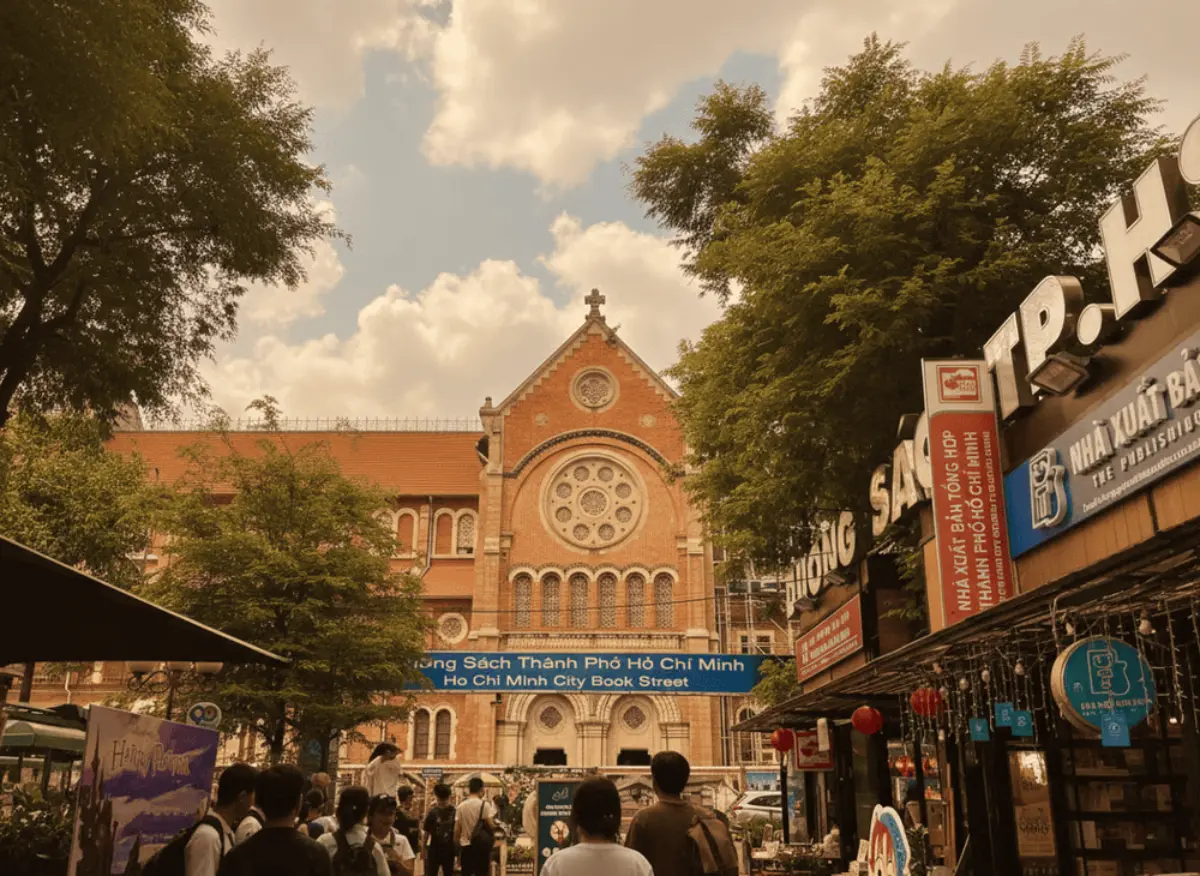
Where other streets roar with engines, Book Street whispers with the rustle of pages. The pavement is lined with symmetrical concrete benches shaded by massive, old Sao trees. Dozens of bookstores — housed in sleek, modern glass pavilions — sell everything from Vietnamese literary classics and English bestsellers to antique maps and children’s pop-up books.
But Book Street is more than a retail space. It is a cultural hub. On weekends, the street hosts poetry readings, calligraphy demonstrations (especially during Tết, the Lunar New Year), and art exhibitions. You will see elderly monks reading Buddhist scriptures next to teenagers studying for exams, all sharing the same quiet respect for the written word. Coffee shops on the ground floor of the adjacent buildings spill out onto the pavement, allowing you to sip a cà phê sữa đá while reading a novel. For tourists, it is the perfect place to buy a beautifully illustrated coffee table book about Vietnam or a postcard that you will walk thirty seconds to mail from the famous post office.
A Self-Guided Walking Tour of Saigon’s Heritage Triangle
Start at Notre-Dame Cathedral (8:00 AM – 10:00 AM): Walk the perimeter, admire the brickwork, and listen for the bells. The morning light is best for photography.
Then, cross the square to the Central Post Office (10:00 AM – 12:00 PM): Explore the historic maps, sit at a writing desk, and mail a letter home. Don’t miss the antique phone booths and the mechanical clock.
By noon, retreat to Book Street (12:00 PM – 2:00 PM): Have lunch at a nearby cơm tấm (broken rice) stall, then grab an iced coffee at one of Book Street’s cafes. Sit under the trees, read a few pages, and watch the light shift through the cathedral’s stained glass.
The title of “second most beautiful” is subjective but generally refers to rankings by The Guardian or architectural digests. It ranks second not because of a lack of beauty, but because the winner usually holds a more “pure” architectural style or greater historical distinction. However, for the traveler, “second best” is actually a gift. Unlike the world’s number one landmark, which is often a mob scene of selfie sticks, the Saigon Central Post Office is spacious, serene, and functional.
Quick Reference: Saigon Central Post Office
Address: 2 Cong Xa Paris Street, District 1, Ho Chi Minh City
Architect: Marie-Alfred Foulhoux (iron framework by Gustave Eiffel)
Completed: 1891
Architectural Style: Neo-Renaissance with Gothic and Art Deco elements
Opening Hours: Daily 6:00 AM – 10:00 PM
Pro Tip: Buy a postcard at Book Street, then mail it from the post office. The antique writing desks are perfect for composing a handwritten note.
In a city that moves at the speed of a motorbike, the Saigon Central Post Office, together with the stoic Cathedral and the intellectual Book Street, forms a triangle of tranquility. It is second only in rank, but first in the hearts of those who have written a letter beneath its iron ribs, prayed beneath its French bricks, and read a poem in the shade of its ancient trees.