
The Last Curve
of the Rails
Luang Prabang: The Timeless Soul
Dawn Alms & Golden Spires
I began my trip in Luang Prabang, that sleepy jewel on the Mekong. At 5:30 AM, I joined the silent river of saffron robes as monks walked the dew-wet streets for the Tak Bat. No words were spoken. Only the soft pad of bare feet and the clink of sticky rice baskets. In that half-dark, I understood something the old Indochine travellers knew: the soul of a place reveals itself before the sun does.
Vang Vieng: The Verdant Playground
Balloons & Blue Lagoons
From there, the railway took me south—not with a jolt, but with a whisper. Two hours later, I was in Vang Vieng. The backpacker chaos of old has been washed clean by the river and replaced by something more elegant: limestone karsts that pierce clouds like forgotten cathedrals. I took a hot air balloon at dawn. Below me, the Nam Song River curled like a silk ribbon. Above me, only the vast, indifferent sky. I thought: This is what they mean by Indochine Chic—not luxury for its own sake, but beauty earned through patience.
Vientiane: The Capital of Cool Serenity
Golden Stupas & Sunset Beerlao
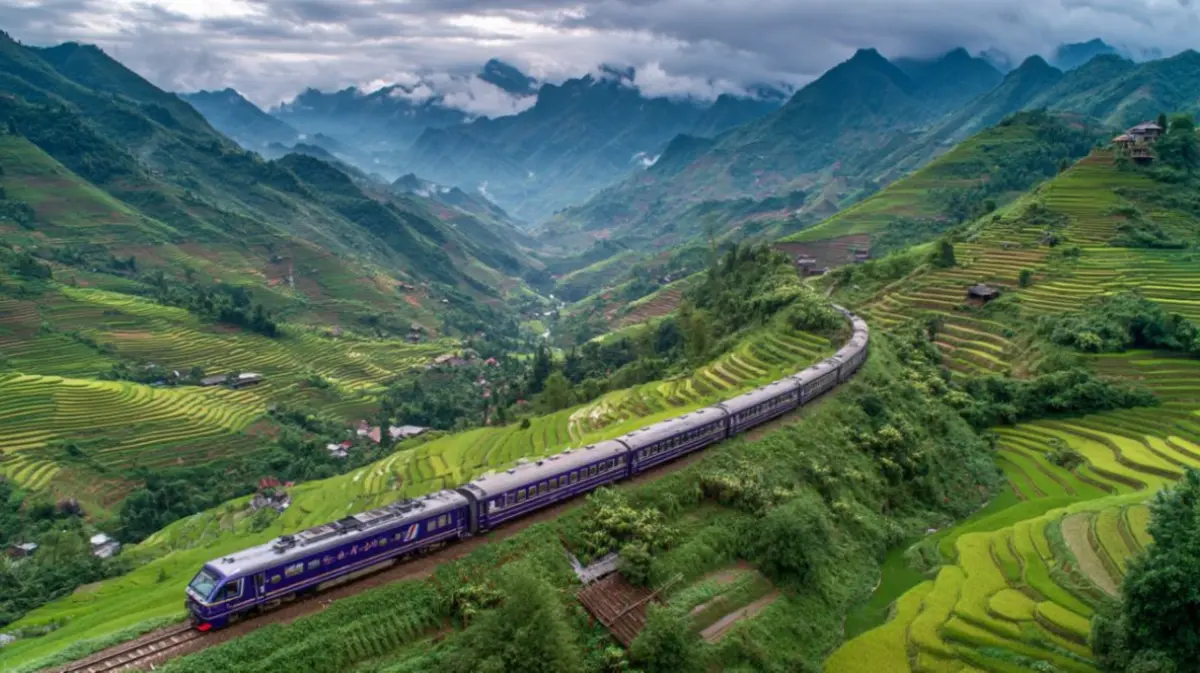
The train again. First class this time—wider seats, quiet carriage, a coffee that tasted of Lao beans and French colonial memory. I watched farmers in conical hats tend rice paddies that looked like shattered mirrors. Vientiane is a capital that refuses to rush. At Pha That Luang, the golden stupa glowed under the late afternoon sun like a promise kept. That evening, I sat on the Mekong riverfront, a cold Beerlao in my hand, and watched the sun dissolve into Thailand across the water. A woman beside me sold grilled bananas. Her smile was the kind you cannot buy.
The Liberation of Distance
Three cities. One railway. And yet, the journey was not about the destinations. It was about the between. Because here is the secret that no guidebook tells you: the Laos–China Railway has not modernised this country. It has liberated it. Liberation from twelve-hour bus rides that broke your spine. Liberation from the tyranny of the rushed itinerary. Now, you can linger in Luang Prabang for four days and still have time for Vang Vieng’s lagoons and Vientiane’s night market. Now, you can travel not as a conqueror of distances, but as a guest of the landscape.
To travel Indochine Chic is to move with intention. It means rising early for the monks, then napping through the afternoon heat in a colonial hotel with ceiling fans that click like metronomes. It means letting the railway be your lazy river through a region that rewards the patient.
I left Laos on a Tuesday morning. My train from Vientiane to the border was half-empty, so I stretched out across two seats and watched the last rice fields dissolve into memory. The woman beside me—a Lao grandmother with betel-nut teeth—pressed a mango into my hand. No words. Just the fruit, the window, the click of the rails.
That, dear traveller, is Indochine Chic. Not a style. A way of being.
— Joueny, April 2026
Caboose Curiosities: Fascinating Facts About the Train
- The “Electric Silk Road” — The railway runs entirely on electricity, saving an estimated 300,000 tonnes of CO₂ per year compared to road transport.
- It Breathes — Over 60% of the line passes through tunnels and across bridges. The Luang Prabang Tunnel is 8.2 km long—nearly six minutes inside a mountain.
- The “No-Honk” Rule — Laser sensors and AI replace loud horns, making the ride near‑silent through villages.
- A Moving Art Gallery — Each station is a masterpiece of Lao-Chinese fusion architecture. Vientiane Station’s roof is shaped like a traditional pha biang shawl.
- The “Mango Express” — A dedicated refrigerated car carries fresh Lao mangoes, bananas and coffee to Kunming every morning; by afternoon they appear in Chinese supermarkets.
- Wi-Fi That Works — Stable 4G/LTE throughout, even inside tunnels.
- The Golden Ticket — First-class carriages have power outlets, reading lights, privacy curtains, and UV‑blocking windows that keep the green from washing out.
- It Crosses the Mekong Four Times — Including the 1.4 km Luang Prabang Mekong Bridge, the longest railway bridge in Laos.
- The 15-Minute Border — At Mohan–Boten, a “one‑stop, one‑check” system clears customs in less time than a small coffee.
- A Driver’s View — The cab has 360‑degree cameras and a fatigue‑detection system that monitors the driver’s eyelids.
Next time you ride, raise your coffee cup to the engineers, the tunnel‑diggers—and the grandmother with the mango. Every rail has a story.
Railway Essentials
Use the official LCR Ticket app 3–7 days in advance. Peak season routes (e.g., Vientiane–Luang Prabang) sell out within minutes. Local travel agents can help for a small surcharge.
Dry season (November–April) offers clear skies and comfortable temperatures. December to February is high season—book early.
Absolutely. For a minimal extra cost, you get wider 2‑2 seating, more legroom, power outlets, and quieter carriages—perfect for the Indochine Chic traveller.
Shared electric vans meet every train; cost is about 40,000–50,000 LAK (2‑3 USD) per person into town.
Most nationalities can get a Visa on Arrival at the border or airport. Passport must be valid for at least 6 months.
Since December 2021, the railway has carried over 70 million passenger trips. Cross‑border services have welcomed more than 780,000 international travellers from over 120 countries.