Saigon Returns: The New Name of Downtown Ho Chi Minh City
For nearly fifty years, the name “Saigon” existed in a peculiar state of linguistic limbo. It was officially retired in 1976 when the victorious North Vietnamese government renamed the unified metropolis after beloved leader Ho Chi Minh. Yet, on the lips of taxi drivers, in the lyrics of popular songs, and across the storefronts of backpacker hostels, the name never truly vanished. It was the city’s ghost — a whispered memory of a bustling pre-1975 era.
But in June 2025, that ghost became tangible again. In a historic administrative reform, the government officially resurrected the name “Saigon,” not for the entire sprawling city of over nine million people, but for its most precious parcel of real estate: the historic downtown core. This is not a political reversal or an attempt to turn back the clock. Rather, it is a profound act of cultural reconciliation — a recognition that history and identity cannot be erased by decree.
The establishment of the Saigon Ward (Phường Sài Gòn) marks a new chapter for the city, one where the revolutionary fervor of “Ho Chi Minh City” exists harmoniously with the mercantile, romantic soul of “Saigon.” Indochine CHIC invites you to discover what this historic change means for travelers and residents alike.
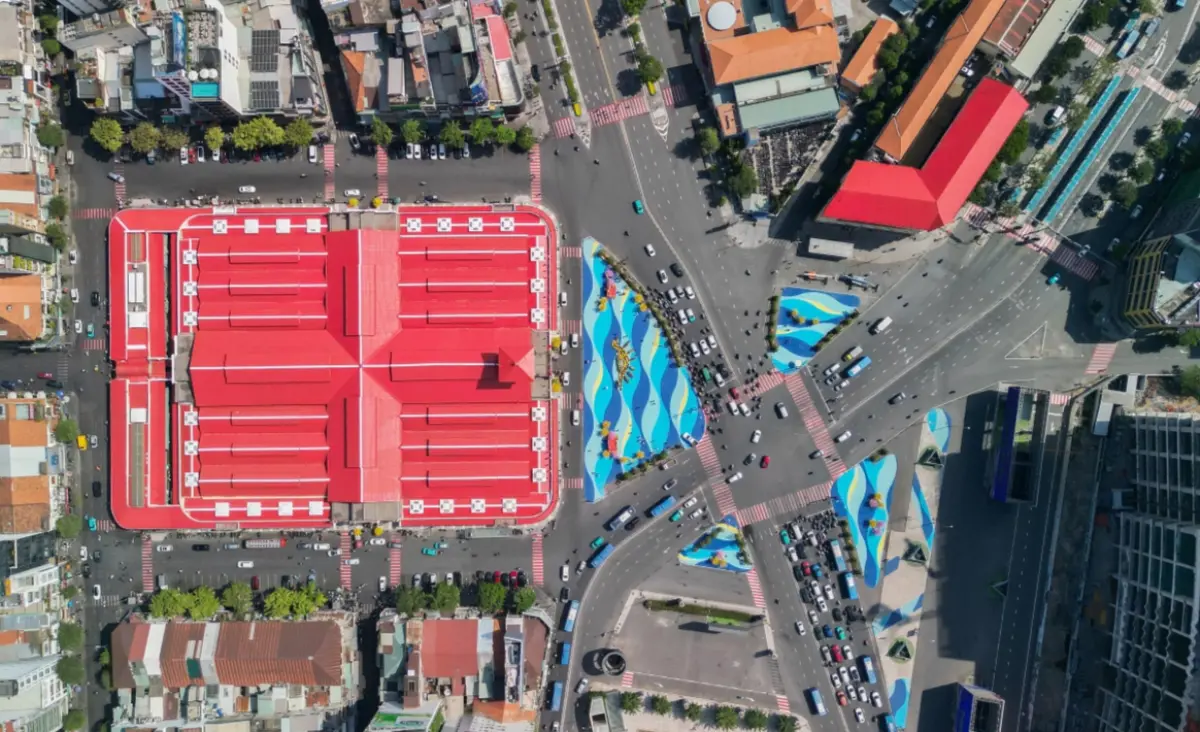
To understand the significance of this change, one must first understand what was lost — and found. Prior to 2025, the beating heart of the metropolis was known administratively as District 1 (Quận 1). It was a term that functioned well on spreadsheets and postal codes but lacked emotional resonance. District 1 was a sterile, numerical designation for a landscape overflowing with history: the gleaming Bitexco Financial Tower, the yellow-hued Saigon Central Post Office, the swirling Art Deco of the Municipal Theatre, and the bustling chaos of Ben Thanh Market.
Under the new reorganization, the old District 1 was dissolved and redrawn. The newly created Saigon Ward now covers approximately 3.04 square kilometers. It was formed primarily by merging the entirety of the former Ben Nghe Ward with significant parts of Nguyen Thai Binh and Da Kao wards. Walking through this new ward, you are walking through the pages of a history book. It is the administrative, financial, and tourist epicenter — home to the Ho Chi Minh City Hall, the luxury hotels of Dong Khoi Street, and the consulates that line Le Duan Boulevard.
For a visitor or resident to truly understand the new Saigon, one must know where it begins and ends. The ward is not an abstract concept; it is a clearly demarcated piece of land bordered by natural waterways and historic thoroughfares.
A Simple Rule of Thumb for Travelers: If you are standing between the Saigon River to the south, the Ben Nghe Canal to the west, the Thi Nghe Canal to the east, and the railway line near Nguyen Van Thu Street to the north — you are in Saigon Ward. More practically: if you can walk to the Central Post Office or Ben Thanh Market in under 15 minutes, you are likely inside the new Saigon.
The decision to name the central ward “Saigon” was not arbitrary. It was the result of a deliberate policy by the Ho Chi Minh City government to move away from numerical naming conventions (Ward 1, Ward 2, etc.) and embrace names with historical and cultural weight.
According to the proposal submitted by the former District 1 authorities, the name “Saigon” was chosen because it is “easily recognizable and familiar to both residents and international visitors.” The government argued that the name serves as a “symbol of pride” and carries a “responsibility to continue the traditional values” of a city rich in heritage.
This marks a significant softening of the hardline stance taken immediately after the Fall of Saigon in 1975. For decades, using “Saigon” was seen by some as tacit sympathy for the old regime. Today, it is viewed as a savvy branding exercise and a genuine act of respect for local identity. The ward is bordered by the Saigon River and the Ben Nghe and Thi Nghe canals — geographic features intrinsically tied to the city’s original settlement as a trading port.
For the traveler arriving today, the creation of Saigon Ward offers a convenient way to navigate the city’s chaos. If you stay within the boundaries described above — specifically the rectangle between the canals and the river — you are staying in the “Saigon” of legend.


The designation of this area as Saigon Ward also reinforces its status as Vietnam’s undisputed economic capital. The ward is home to the Ho Chi Minh City Stock Exchange and the Vietnamese headquarters of virtually every major international bank, from HSBC to JPMorgan Chase.
Furthermore, it is the diplomatic heart of the country. Le Duan Boulevard, which runs along the northern edge of the ward (just south of the Ben Nghe Canal boundary), is often called “Embassy Row.” Here you will find the Consulates General of the United States, the United Kingdom, France, Australia, China, and Japan, among many others. The concentration of flags from around the world flying over this small patch of land is a testament to Saigon’s enduring role as a global city — a role it has played since it was a Khmer trading village known as Prey Nokor.
Quick Reference: Saigon Ward at a Glance
Area: Approximately 3.04 square kilometers
Former Name: District 1 (Quận 1) — dissolved and redrawn
Formed From: Ben Nghe Ward (entirely) + parts of Nguyen Thai Binh and Da Kao wards
Key Landmarks: Ben Thanh Market, Central Post Office, Notre Dame Cathedral, Nguyen Hue Walking Street, City Hall, Opera House
Bordering Waterways: Saigon River (south), Ben Nghe Canal (west), Thi Nghe Canal (east)
So, what does a visitor need to know? Practically speaking, very little has changed on the ground. The street signs reading “District 1” are slowly being replaced, and addresses will eventually update their administrative divisions. However, the psychological shift is immense.
For fifty years, the city suffered a sort of identity crisis. Tourists flew into Tan Son Nhat International Airport (code: SGN) and argued with taxi drivers about whether to call the destination “Saigon” or “Ho Chi Minh City.” Now, that argument is settled with nuance. Ho Chi Minh City remains the official name of the massive municipality — the sprawling metropolis that includes far-flung districts and the new “sub-city” of Thu Duc. But Saigon is officially back on the map as the name of the historic downtown core.
The easiest way to visualize Saigon Ward: Take a map of Ho Chi Minh City. Find the Saigon River flowing from north to south. Find the Ben Nghe Canal entering the river from the west. Find the Thi Nghe Canal entering from the east. The triangle of land between these three waterways — plus the northern railway line — is the new Saigon. It is a district defined by water, history, and the resilient spirit of a city that refused to let its oldest name die.
The city is no longer looking back at the war with a sense of division, but looking forward with a unified identity. The “new name of downtown” is, in fact, the oldest name of all — a testament to the fact that for a city as resilient as this one, a name is never really lost; it is just waiting for the right moment to return.