Reunification Palace: The Historic Heart of Modern Vietnam
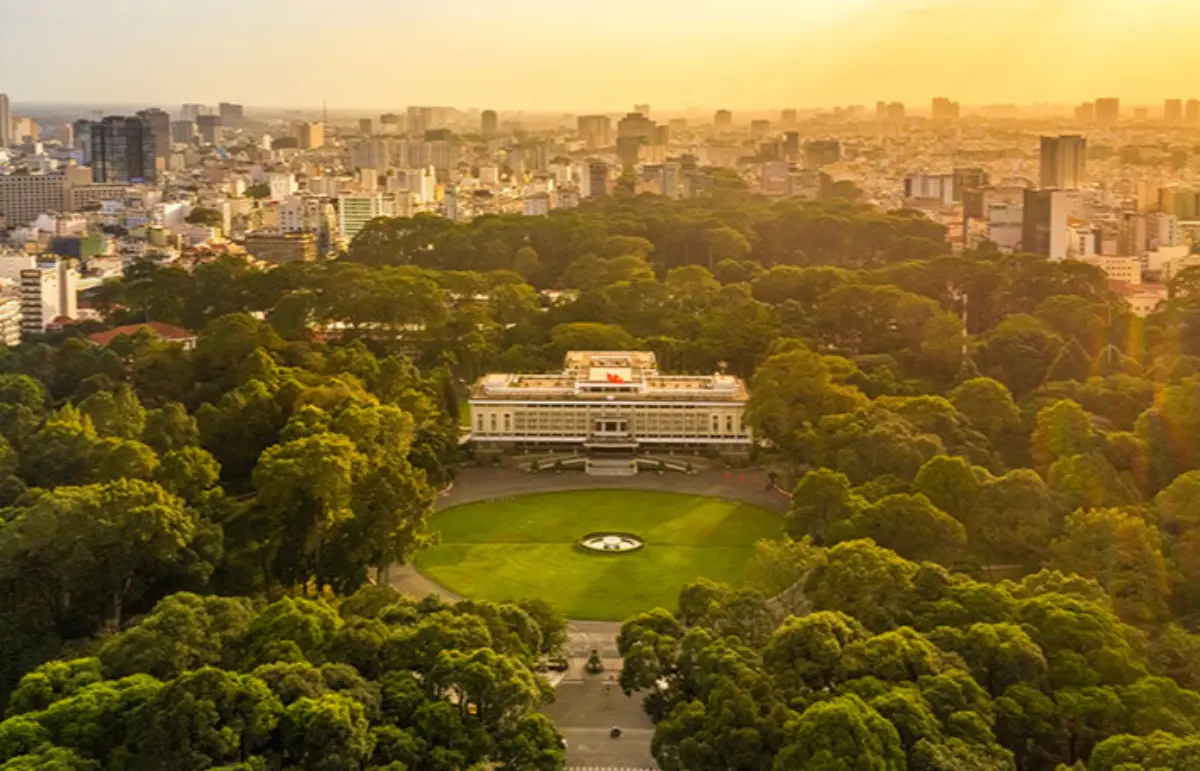
On the morning of April 30, 1975, a North Vietnamese Army tank crashed through the iron gates of the Presidential Palace in Saigon. As the tank climbed the steps of the grand building, the Vietnam War — three decades of conflict that had defined a generation — came to a dramatic and decisive end. Today, that building is known as the Reunification Palace (also called Independence Palace), and it stands as one of the most historically significant landmarks in Southeast Asia.
More than just a museum, the Reunification Palace is a time capsule of 1960s architecture and Cold War politics. Its preserved rooms, underground bunkers, and period furnishings offer visitors an unparalleled glimpse into the final days of the Vietnam War and the complex history of modern Vietnam. Indochine CHIC invites you to explore this extraordinary landmark.
The original palace on this site was the Norodom Palace, built between 1868 and 1873 by French architect Georges Lhermite. Designed in the French neoclassical style, it served as the residence of the French Governor-General of Cochinchina. In 1954, after the French withdrawal, South Vietnamese President Ngo Dinh Diem took up residence and renamed it Independence Palace.
In February 1962, two dissident pilots bombed the palace, leaving the main wing severely damaged but failing to assassinate Diem. Rather than repair the damaged structure, Diem ordered it demolished and commissioned a new, modern palace. Architect Ngô Viết Thụ, a Vietnamese graduate of the École des Beaux-Arts in Paris, won the design competition. His striking modernist design, completed in 1966, would become the iconic building we see today.
The Reunification Palace is a masterpiece of mid-century modern architecture, blending clean lines, open spaces, and subtle Eastern influences. The building’s horizontal massing, cantilevered balconies, and perforated concrete screens (brise-soleil) reflect the influence of Le Corbusier and other modernist architects, while the arrangement of spaces follows traditional Vietnamese principles of harmony and balance.
The palace spans 12,000 square meters across three main floors, a mezzanine, a basement, a rooftop terrace, and two additional wings. The ground floor contains reception halls, banquet rooms, and offices. The second floor housed the president’s living quarters and private reception areas. The rooftop features a helipad, a terrace, and a pavilion where the president could entertain guests with panoramic views of Saigon.
Beneath the palace lies one of its most fascinating features: a 200-meter-long underground bunker complex. Built to withstand bombings, the bunker housed the military command center, communications room, kitchen, medical facilities, and sleeping quarters for key personnel. The concrete walls are over a meter thick in places, and the ventilation system was designed to filter out chemical agents.
Visitors can explore this bunker today, walking through the same corridors where President Nguyen Van Thieu and his generals planned military strategy during the final days of the war. The communications room still contains original radios and switchboards, and the map room displays the deteriorating military situation across South Vietnam in April 1975. It is a haunting and powerful experience.
By late April 1975, the North Vietnamese Army was closing in on Saigon from all sides. On April 21, President Thieu resigned and fled the country, handing power to Vice President Tran Van Huong. Just one week later, Huong also resigned, and General Duong Van Minh took over. He would serve for only two days.
At 10:45 AM on April 30, 1975, North Vietnamese Army tank number 843, commanded by Lieutenant Bui Quang Than, crashed through the palace gates. Minutes later, tank number 390 followed. As soldiers poured into the grounds, they found General Duong Van Minh and his cabinet waiting in the reception hall. “I have been waiting for you since early morning to transfer power,” Minh said. “There is no question of transferring power,” the North Vietnamese officer replied. “You cannot give up what you do not have.”
Historical Milestone: The Reunification Palace was declared a National Special Relic in 1976, preserving it exactly as it appeared on the day Saigon fell. The tanks that crashed through the gates — numbers 843 and 390 — are now displayed in the palace courtyard.
The Presidential Offices: Explore the president’s reception rooms, cabinet meeting room, and living quarters, preserved exactly as they were in 1975.
The Underground Bunker: Descend into the war command center to see the communications room, map rooms, and sleeping quarters where the South Vietnamese leadership spent their final days.
The Rooftop Terrace: Climb to the helipad for panoramic views of Ho Chi Minh City and to see where evacuation helicopters landed during the final hours.
The Tank Display: In the courtyard, see the two North Vietnamese tanks that crashed through the gates — iconic symbols of the war’s end.
The F5E Fighter Jet: A captured South Vietnamese F5E fighter jet, which a defecting pilot flew to a North Vietnamese base, is also on display.
Visitor Information: Reunification Palace
Address: 135 Nam Ky Khoi Nghia Street, District 1, Ho Chi Minh City
Opening Hours: Daily 8:00 AM – 5:00 PM (including public holidays)
Admission: 40,000 VND ($1.70 USD) for adults, 15,000 VND ($0.65 USD) for students, 10,000 VND for children
Guided Tours: Available in Vietnamese, English, French, Chinese, Japanese, and Korean (included with admission)
Average Visit Duration: 1.5 – 2 hours
Pro Tip: Visit early morning (8:00 AM) to avoid crowds and the heat. The underground bunker can be warm and humid.
The Reunification Palace is located near several other major Saigon landmarks. Combine your visit with:
Notre-Dame Cathedral and Central Post Office: A 10-minute walk from the palace, these French colonial landmarks offer stunning architecture and photography opportunities.
War Remnants Museum: A 15-minute walk away, this museum provides powerful context to the war you’ll learn about at the palace.
Ben Thanh Market: Located 15 minutes away, the market is perfect for lunch and souvenir shopping after your palace tour.
The Reunification Palace is more than a museum — it is a witness to history. Unlike many historic buildings that have been extensively renovated, the palace was preserved exactly as it was on April 30, 1975. The cabinets still hold documents from the final days. The maps still show the positions of North Vietnamese divisions approaching Saigon. The ashtrays still contain cigarette butts from sleepless nights.
For Vietnamese people, the palace represents the triumph of reunification and the end of decades of war. For international visitors, it offers an extraordinary opportunity to walk through a pivotal moment in 20th-century history. The Reunification Palace does not moralize or editorialize — it simply presents the facts and allows visitors to draw their own conclusions. That restraint makes it one of the most powerful historical sites in Southeast Asia.
The tanks that crashed through these gates are still here. The president’s chair is still in place. The maps still show the final battle plans. At the Reunification Palace, history is not behind glass — it is all around you, waiting to be discovered.