Top 10 French Colonial Architecture Sites in Hue Imperial City | Indochine CHIC Guide
Top 10 French Colonial Architecture Sites in Hue Imperial City
Where Nguyen Dynasty Grandeur Meets Indochine Elegance
Hue, the ancient imperial capital of Vietnam, is renowned for its majestic citadels, royal tombs, and pagodas. But beneath its traditional Vietnamese identity lies a fascinating layer of French colonial architecture in Hue that few travelers fully appreciate. Unlike Hanoi or Saigon, Hue’s French colonial architecture tells a unique story of cultural fusion — where European neoclassical forms were adapted to tropical climates and blended with Nguyen Dynasty aesthetics.
From 1885 to 1945, the French protectorate over Annam (central Vietnam) transformed Hue into a city of contrasts. French administrators, alongside Vietnamese royalty, built elegant villas, schools, churches, and public buildings that harmonized Eastern and Western design principles. These Indochine buildings represent a unique architectural heritage found nowhere else in the world. This guide by Indochine CHIC unveils the 10 most magnificent French colonial architecture sites in Hue Imperial City — each a testament to a unique chapter in Vietnam’s complex history.
1. An Dinh Palace
97 Phan Dinh Phung Street, Hue City
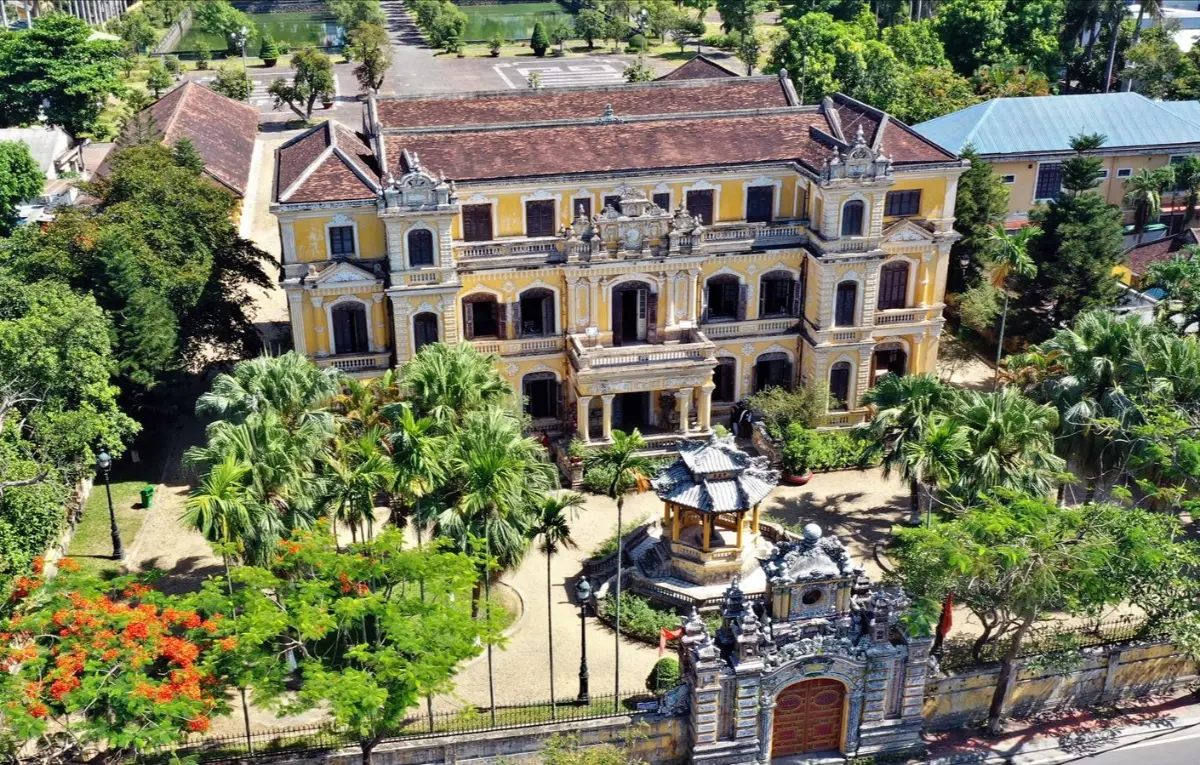
Built between 1917 and 1919 by Emperor Khai Dinh, this exquisite palace represents the most sophisticated fusion of Vietnamese, French, and Italian architectural styles. The three-story structure features a distinctive French neoclassical facade adorned with intricate stucco reliefs, yet incorporates traditional Vietnamese curved roofs and interior layouts. The palace served as the private residence of the imperial family and later became the childhood home of Emperor Bao Dai. Inside, the “Nine Dragon Ceiling” mural and the reception hall’s European-inspired decor reveal the emperor’s cosmopolitan tastes. After years of neglect, An Dinh Palace has been beautifully restored and now houses a museum dedicated to Emperor Khai Dinh’s life. This is a prime example of French colonial architecture in Hue blending with royal Vietnamese traditions.
Indochine fusion | 1917-1919 | Emperor Khai Dinh
2. La Résidence Hotel & Spa
5 Le Loi Street, Hue City
Originally constructed in 1930 as the residence of the French Resident Supérieure (the highest-ranking French official in central Vietnam), this stunning Art Deco building has been meticulously restored into one of Hue’s most luxurious boutique hotels. The hotel’s white facade, with its distinctive horizontal lines, curved corners, and nautical-inspired railings, exemplifies the streamlined elegance of the Art Deco movement within French colonial architecture in Hue. The property sits along the Perfume River, offering spectacular views of the Imperial Citadel. Notable guests have included Charlie Chaplin and his wife Paulette Goddard during their world tour in 1936. The building’s original architectural details, including terrazzo floors and period furnishings, have been carefully preserved.
Art Deco | 1930 | French Governor’s residence
3. Quốc Học Hue High School
12 Le Loi Street, Hue City
Founded on September 17, 1896, by French Governor-General Paul Doumer, Quốc Học is one of Indochina’s oldest and most prestigious educational institutions. The school’s architecture masterfully blends French colonial functionality with tropical adaptations — featuring long, airy corridors, shuttered windows, and high ceilings designed for ventilation. The main building’s ochre-yellow facade, a hallmark of French colonial civic architecture, is accented with white trim and green shutters. Quốc Học gained historical significance as the alma mater of Vietnam’s beloved revolutionary leader, Hồ Chí Minh, who studied here in the early 1900s. The school remains one of Vietnam’s top secondary institutions, and its well-preserved campus is a hidden gem of French colonial architecture in Hue.
French colonial | 1896 | Hồ Chí Minh’s alma mater
4. Hue Railway Station (Ga Huế)
2 Bui Thi Xuan Street, Hue City
Completed in 1906 as part of the Trans-Indochinois railway connecting Hanoi to Saigon, Hue Railway Station is a charming example of colonial-era transportation architecture. The station building features a distinctive curved facade, arched windows, and a central clock tower — all signature elements of French railway station design. The ochre-yellow and white color scheme matches other French civic buildings in Hue, creating architectural harmony across the city. Though the station underwent renovations in the 1970s, its original character remains intact. The station still operates daily trains along Vietnam’s scenic “Reunification Express” line, making it a living piece of French colonial architecture in Hue.
French colonial | 1906 | Reunification Express
5. Museum of Royal Antiquities (Long An Palace)
3 Le Truc Street, Hue City
Built in 1845 under Emperor Thieu Tri, Long An Palace predates the French arrival but underwent significant French-influenced modifications during the colonial period. The building’s elevated position on a stone platform, its spacious wooden interior, and its surrounding gardens reflect a fusion of traditional Nguyen Dynasty architecture with European landscape design principles. During the French protectorate, the palace was used for official receptions and later became the residence of the French Résident. Today, it houses the Museum of Royal Antiquities, displaying over 11,000 artifacts from the Nguyen Dynasty. This unique blend makes it a fascinating example of how French colonial architecture in Hue adapted existing structures.
Traditional with French influences | 1845 | Royal antiquities
6. French Quarter Villas (Le Loi Street)
Le Loi Street, Hue City
Stretching along the Perfume River’s southern bank, the French Quarter contains some of Hue’s best-preserved colonial residential architecture. These elegant villas, built between 1910 and 1940, served as homes for French administrators, military officers, and wealthy Vietnamese collaborators. The houses feature characteristic French colonial elements: shuttered windows, high ceilings, terrazzo floors, wrought-iron balconies, and wrap-around verandas designed for tropical climates. Many of these villas have been converted into cafes, galleries, and boutique hotels, allowing visitors to experience their charm firsthand. The tree-lined boulevards of Le Loi and Tran Hung Dao streets offer the perfect setting for a leisurely architectural walking tour of French colonial architecture in Hue.
French colonial villas | 1910-1940 | Riverside quarter
7. Đông Ba Market
Tran Hung Dao Street, Hue City
Established in 1887 during the French colonial period, Đông Ba Market is Hue’s oldest and largest traditional market. The original market hall, rebuilt in 1975 after fire damage, retains the essential features of French colonial market architecture: a large open hall with high ceilings, arched entryways, and a central clock tower. The market’s strategic location at the intersection of the Perfume River and major roads made it the commercial heart of colonial Hue. Today, the market remains a bustling hub of local life, offering everything from fresh produce and seafood to textiles and souvenirs. This is a living example of how French colonial architecture in Hue served everyday commerce.
French colonial market | 1887 | Historic commercial hub
8. Redemptorist Church (Our Lady of Perpetual Help)
158 Nguyen Hue Street, Hue City
Completed in 1940 by French Redemptorist missionaries, this striking church combines French Gothic Revival architecture with local Vietnamese elements. The twin bell towers rise 35 meters high, while the nave features pointed arches, ribbed vaults, and large stained-glass windows imported from France. What makes this church unique is the incorporation of Vietnamese decorative motifs — including stylized lotus flowers and dragons — into the Gothic framework. The church survived the 1968 Tet Offensive and 1975 reunification relatively intact, becoming an important pilgrimage site for central Vietnam’s Catholic community. This sacred site represents the spiritual dimension of French colonial architecture in Hue.
French Gothic | 1940 | Vietnamese motifs
9. French Consulate Building (Former French Residency)
12 Le Loi Street, Hue City
This elegant neoclassical building, constructed in the early 1920s, served as the office and residence of the French Resident Supérieure — the highest French official in central Vietnam. The two-story structure features a symmetrical facade with Corinthian columns, arched windows, a mansard roof, and a prominent central entrance with a grand staircase. The building’s prime location opposite the Perfume River offered both strategic advantage and aesthetic beauty. After 1954, the building served various government functions and now houses the French Consulate in Hue. The building’s interior retains original mosaic floors, high ceilings, and period details, making it one of Hue’s most distinguished examples of French colonial architecture in Hue.
Neoclassical | 1920s | Active consulate
10. French Cemetery Memorial (An Cựu Cemetery)
An Cuu Area, Hue City (near the train station)
While largely overgrown and forgotten, the remnants of the French colonial cemetery in the An Cuu district provide a haunting glimpse into the lives of French civilians, soldiers, and missionaries who lived and died in colonial Hue. The cemetery’s surviving tombstones, mausoleums, and religious statuary reflect a range of 19th and early 20th-century European funerary styles — from simple crosses to elaborate Gothic Revival and Art Deco monuments. Though most of the cemetery was disturbed after 1954, several notable graves remain, including those of early French missionaries and colonial administrators. This site offers a poignant counterpoint to Hue’s grand imperial tombs, reminding visitors of the complex human cost behind French colonial architecture in Hue.
Funerary architecture | 19th-20th century | Historical cemetery
Beyond the Top 10: You can also find other French colonial buildings in Hue, including the former Post Office on Le Loi Street, the Court of Justice building, and numerous hidden villas along Tran Hung Dao and Nguyen Tri Phuong streets. Each structure tells a unique story of cultural exchange and architectural adaptation, making Hue a fascinating destination for heritage travelers interested in French colonial architecture in Hue.
Self-Guided Walking Tour Suggestion: Start at Quốc Học School (morning light is best for photos), then walk along Le Loi Street past the French Consulate and French Quarter villas to La Résidence Hotel. Cross the Perfume River to visit An Dinh Palace, then take a short taxi ride to Hue Railway Station. This route covers six of our top 10 French colonial architecture sites in Hue Imperial City and can be completed in 3-4 hours at a leisurely pace.
Hue’s French colonial architecture tells a story not of domination, but of dialogue — a conversation between East and West that produced something entirely unique. In the shadow of the Imperial Citadel’s towering flag tower, these neoclassical villas, Art Deco hotels, and Gothic churches remind us that history is never one-sided. The Nguyen emperors who collaborated with the French built palaces that blended both traditions; the Vietnamese students who studied in French-built schools later led independence movements. As you walk Hue’s tree-lined boulevards, you walk through layers of time — each building a chapter in Vietnam’s complex, resilient, and endlessly fascinating story of Indochine buildings.
— Indochine CHIC Heritage Guide
Free Tour plan & Quote... inbox
Travel Activities and Experiences
Travel Services
Cruise Booking
Hotel Booking
Customize Service
Custom Tour Enquiry | Vietnam · Laos · Cambodia · Thailand | Asia Travelmates
Tailor-made journeys | Explore beyond borders
Custom Tour Enquiry — Indochina & Beyond
Vietnam · Laos · Cambodia · Thailand · Myanmar · Malaysia Share your dream itinerary, and Kristal — our travel curator — will craft your private adventure.