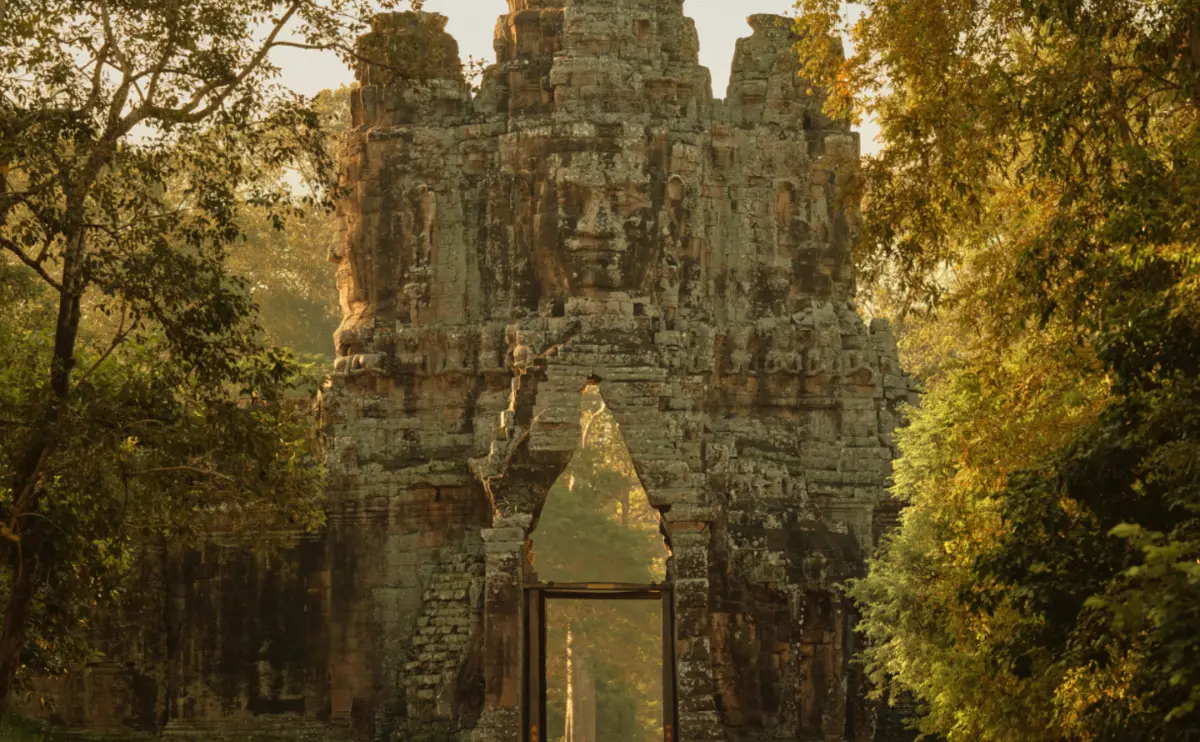
There is a moment when you first see the face of Bayon — a serene smile carved from stone, gazing in four directions, eternal and unknowable. Then you realize there are 216 of them, rising in tiered towers, watching over the last great capital of the Khmer Empire. Angkor Thom, the “Great City,” was Jayavarman VII’s masterpiece: a sprawling metropolis of temples, terraces, and causeways that once housed over a million souls. Indochine CHIC invites you to explore this architectural wonder, where history whispers from every stone and the faces of the bodhisattva Avalokiteshvara still smile after eight centuries.
The Experience – Entering the Great City
You approach Angkor Thom through the South Gate, a stone causeway flanked by 54 gods on the left and 54 demons on the right, each carrying the body of a seven-headed naga serpent. The gate itself is a towering stone face, four meters high, gazing out over the moat. As your vehicle passes beneath, you feel a shift — you are no longer in the present, but entering a realm where kings were gods and the city was a mandala of cosmic order.
The road leads you through jungle, past the ruined temple of Phimeanakas, the Royal Palace’s ceremonial pyramid, until the towers of Bayon rise before you. Unlike Angkor Wat’s linear grandeur, Bayon is a labyrinth — a chaotic, sublime maze of towers and galleries. You wander without map, turning corners to encounter another face, another smile. The light shifts through the stone corridors, and for a moment, you are alone with the thousand-year gaze of a king who built this city as a reflection of heaven.
“The faces of Bayon are not merely decorative — they are the presence of the bodhisattva Avalokiteshvara, and by extension, the deified king himself. To stand among them is to feel the weight of divine kingship and the compassion of the Buddha, watching over the empire for eternity.”
Beyond Bayon, the city unfolds: the Terrace of the Elephants, where the king once reviewed his victorious armies; the Terrace of the Leper King, with its haunting carved figures; and the scattered ruins of temples, palaces, and reservoirs that hint at the scale of this lost metropolis. A full exploration requires hours, perhaps days — but even a single visit leaves an indelible mark.
Bayon Temple – The Mountain of Stone Faces
Bayon is the state temple of Jayavarman VII, built in the late 12th century as the centerpiece of Angkor Thom. Its most distinctive feature is the 37 standing towers, each carved with four faces oriented to the cardinal directions. The central tower rises 43 meters, crowned by four faces that gaze out over the kingdom. Scholars debate whether the faces represent the bodhisattva Avalokiteshvara, King Jayavarman VII himself, or a fusion of both — a king who became a god of compassion.
The Bas-Reliefs
The outer gallery of Bayon contains over 1,200 meters of bas-reliefs, unique among Angkorian temples for their depictions of everyday life alongside historical battles. Here you will see Khmer soldiers fighting Cham invaders, markets and cockfights, fishermen on Tonle Sap, and scenes of childbirth and death. Unlike the mythological narratives of Angkor Wat, Bayon’s reliefs tell the story of the Khmer people themselves.
The Best Time to Visit
Bayon is at its most magical in the late afternoon, when the low sun casts golden light across the faces, deepening the shadows and bringing the stone to life. Early morning offers solitude, but the faces are backlit until mid-morning. For photography, aim for 3:00 PM to 4:30 PM, when the eastern faces glow warmly and crowds have thinned.
Exploring the Labyrinth
Unlike the orderly corridors of Angkor Wat, Bayon is meant to be wandered. Allow at least 90 minutes to explore the lower galleries, the central towers, and the upper terrace. The most famous faces — the “smiling Buddha” images — are located on the upper level, accessible via steep stairs. Go early or late to experience them without tour groups.
Photography Tip: The iconic close-up shots of the faces are best achieved with a telephoto lens (70-200mm) from the upper terrace. For environmental portraits, frame the faces through stone doorways or against the sky. The light is most dramatic between 2:00 PM and 4:00 PM.
The Five Gates – Entering the Cosmic City
Angkor Thom is enclosed by a square wall 3 kilometers on each side, surrounded by a 100-meter-wide moat. The city has five gates, each crowned with four stone faces and approached by a causeway lined with gods and demons. Each gate is aligned with a cardinal direction, with the Victory Gate providing access to the Royal Palace area.
South Gate
The most visited and best-preserved gate. The causeway features 54 gods on the left and 54 demons on the right, making it the classic Angkor Thom entrance. Best photographed in the morning light, when the faces are illuminated from the front.
North Gate
The quietest entrance, offering solitude and the same magnificent architecture without crowds. The road from the North Gate leads past Preah Khan and is a favorite for cyclists and those seeking an authentic approach.
Victory Gate
Located on the eastern wall, this gate leads directly to the Royal Palace and the Terrace of the Elephants. The causeway here is shorter but equally impressive, and the gate is less crowded than the South Gate.
West Gate and East Gate
Both are largely unrestored and rarely visited, offering a glimpse of the gates in their original, jungle-embraced state. The East Gate in particular feels like a true discovery, with vegetation overtaking the ancient stones.
Insider Secret: The most atmospheric approach to Angkor Thom is from the West Gate at sunset. The gate faces east, so the setting sun illuminates the faces from behind, creating dramatic silhouettes. The road from the West Gate to Bayon passes through dense jungle, offering a sense of how 19th-century explorers first encountered the city.
The Royal Terraces – Where Kings Held Court
Immediately north of Bayon lie two of Angkor Thom’s most dramatic structures: the Terrace of the Elephants and the Terrace of the Leper King. These were not temples but viewing platforms and ceremonial stages, where the king observed parades, received ambassadors, and presided over public rituals.
Terrace of the Elephants
Stretching over 300 meters, this terrace is named for the carved elephants that line its walls, their trunks forming pillars and their bodies adorned with lotus flowers. The central section features three-headed elephants (Airavata) and garudas, while the five-tiered platform at the center was the king’s royal viewing stand. From here, Jayavarman VII would have watched his armies return victorious from battle.
Terrace of the Leper King
North of the Elephant Terrace, this structure takes its name from a 15th-century statue found here, its surface worn smooth by time. The terrace walls are covered in exquisite carvings of nagas, demons, and celestial beings, arranged in tiered rows. A later discovery revealed a second, inner wall — a “hidden terrace” that was buried for centuries, now accessible via a narrow passage where the carvings are exceptionally well-preserved.
Beyond Bayon – Discovering Angkor Thom’s Hidden Treasures
Phimeanakas: A three-tiered pyramid within the Royal Palace enclosure, once topped with a golden tower. Legend held that the king nightly ascended to meet the naga princess who ruled the Khmer kingdom — a myth that reinforced his divine right to rule.
Baphuon: A massive temple-mountain built in the 11th century, now restored after decades of painstaking reconstruction. The temple is approached by a 200-meter elevated causeway, and its western face features a reclining Buddha added in the 16th century, measuring 70 meters in length.
Preah Palilay: A small, atmospheric temple hidden in the forest north of the Royal Palace, often overlooked by visitors. The single sandstone tower is draped in the roots of a massive fig tree, offering a Ta Prohm-like experience without the crowds.
Prasat Chrung: Small corner temples located at each of the city’s four corners, offering quiet respite and views over the surrounding moat and countryside. The southwest corner temple is the most accessible and least visited.
Explorer’s Note: A full exploration of Angkor Thom requires at least half a day. Consider arriving at 8:00 AM to visit Bayon before the crowds, then exploring the terraces and Baphuon before midday. The afternoon is ideal for the quieter gates and hidden temples. A knowledgeable guide can unlock the layers of history and symbolism that make this city one of humanity’s greatest achievements.
Logistics & Planning – How to Experience Angkor Thom
Angkor Pass: Angkor Thom is included in the standard Angkor Pass. A 3-day pass ($62) is recommended to explore both the Grand Circuit (Angkor Thom, Preah Khan, Ta Prohm, etc.) and the Small Circuit (Angkor Wat, Bayon, etc.) without rushing.
Transportation: A private tuk-tuk costs $20-25 for a full day covering Angkor Thom and surrounding temples. For a more comfortable experience, hire an air-conditioned car ($40-60) or book a private guide with transport through your hotel. Cycling enthusiasts can rent bicycles for $3-5 per day — the flat terrain and shaded roads make this an excellent option.
Timing: Arrive at the South Gate by 8:00 AM to cross the causeway before tour buses. Visit Bayon between 8:30 AM and 9:30 AM for manageable crowds and good light on the eastern faces. The Terrace of the Elephants is best in the morning light, while the hidden terrace of the Leper King is less crowded after 2:00 PM.
What to Bring: Comfortable walking shoes, sun protection (hat, sunscreen, sunglasses), water, and a scarf for temple entry. The ruins involve uneven stone surfaces and steep stairs — sturdy footwear is essential.
Insider Secret: The narrow passage behind the Terrace of the Leper King (the “hidden terrace”) is often empty even during peak hours. Enter from the north end and walk the 50-meter corridor lined with remarkably preserved carvings of nagas, apsaras, and demon kings — one of Angkor’s most intimate and underappreciated experiences.
Where to Stay – Hotels That Complement the Experience
Amansara
The ultimate Angkor experience. Amansara’s private guides can arrange after-hours access to Bayon, allowing you to witness the stone faces in solitude as the sun sets. Vintage Mercedes transport completes the experience.
Raffles Grand Hotel d’Angkor
The colonial grande dame offers expert-led tours of Angkor Thom, with guides who can trace the history from Jayavarman VII to the present day. Return for afternoon tea on the terrace, reflecting on the day’s discoveries.
Jaya House River Park
Eco-luxury with a conscience. Jaya House provides complimentary tuk-tuk transport and can arrange guides who specialize in the symbolism and spiritual significance of Bayon’s 216 faces.
Shinta Mani Shack
Located in the French Quarter, this Bensley-designed boutique offers personalized itineraries that include off-the-beaten-path exploration of Angkor Thom’s lesser-known corners, like the West Gate and Preah Palilay.
The Eternal Smile
Bayon’s faces do not merely watch — they welcome, they witness, they remember. Eight centuries of sunrises and monsoons have not diminished their serenity. To walk among them is to understand something profound about the Khmer spirit: that even in empire’s ruin, compassion endures. Whether you come for history, architecture, or the simple awe of standing before 216 stone smiles, Angkor Thom will leave you changed.
— The Indochine CHIC Team
Top 5 Hotel gallery
Custom Tour Enquiry | Vietnam · <a href="https://indochinechic.com/songkran-beyond-16-days-through-thailand-laos-and-cambodia/">Laos</a> · Cambodia · Thailand | Asia Travelmates
Tailor-made journeys | Explore beyond borders
Custom Tour Enquiry — Indochina & Beyond
Vietnam · Laos · Cambodia · Thailand · Myanmar · Malaysia Share your dream itinerary, and Kristal — our travel curator — will craft your private adventure.
Top 10 Indochina Destinations
Top 5 luxury hotels in Vietnam from Indochine CHIC’s client favorites—yet countless other finest properties across Vietnam await your stay.