Indochine Chic
Luxury travel experiences crafted with elegance and authenticity.

A pink‑bricked “Notre‑Dame” rising from the jungle – where Gothic grandeur meets the red soil of Đắk Lắk
Words by Indochine Chic · 12 min read · updated for 2026

You don’t expect to find a Gothic cathedral in the middle of Đắk Lắk’s sun‑baked plateau. But there it stands – two sharp bell towers piercing the blue sky, their red‑brick silhouette catching the first light of dawn and holding it until dusk. This is Nhà Thờ Buôn Hồ (Buon Ho Church), a rare architectural jewel that has earned the nickname “the Notre‑Dame of the Central Highlands.” While much of Vietnam’s Tây Nguyên region is known for volcanic red soil, endless coffee plantations, and the deep sound of traditional music at communal houses, Buon Ho Church offers a striking contrast: a Western Gothic masterpiece patiently “localised” for the tropical climate and the resilient spirit of its migrant parishioners. This guide explores every aspect of the church – from its soaring Gothic features and unique pink‑brick façade to its turbulent history, the role it plays in the local community, and practical tips for visiting this off‑the‑beaten‑path destination.
| Category | Quick Answer |
|---|---|
| Official Name | Buôn Hồ Parish Church |
| Location | Buôn Hồ Town, Đắk Lắk Province, Central Highlands of Vietnam |
| Architectural Style | Gothic Revival with vernacular adaptations |
| Notable Feature | Tall pink‑brick bell towers; two towers creating a “visual anchor” |
| Current Building Completed | 2010 (foundation stone laid in 2008) |
| Total Ground Area | Over 1,200 m² |
| Original Chapel | Built in 1965 with wooden planks and corrugated iron roof |
| Key Colour | Distinct reddish‑terracotta – rare among churches in the Central Highlands |
| Best Time to Visit | Early morning (6–8 AM) or late afternoon (3–5 PM) |
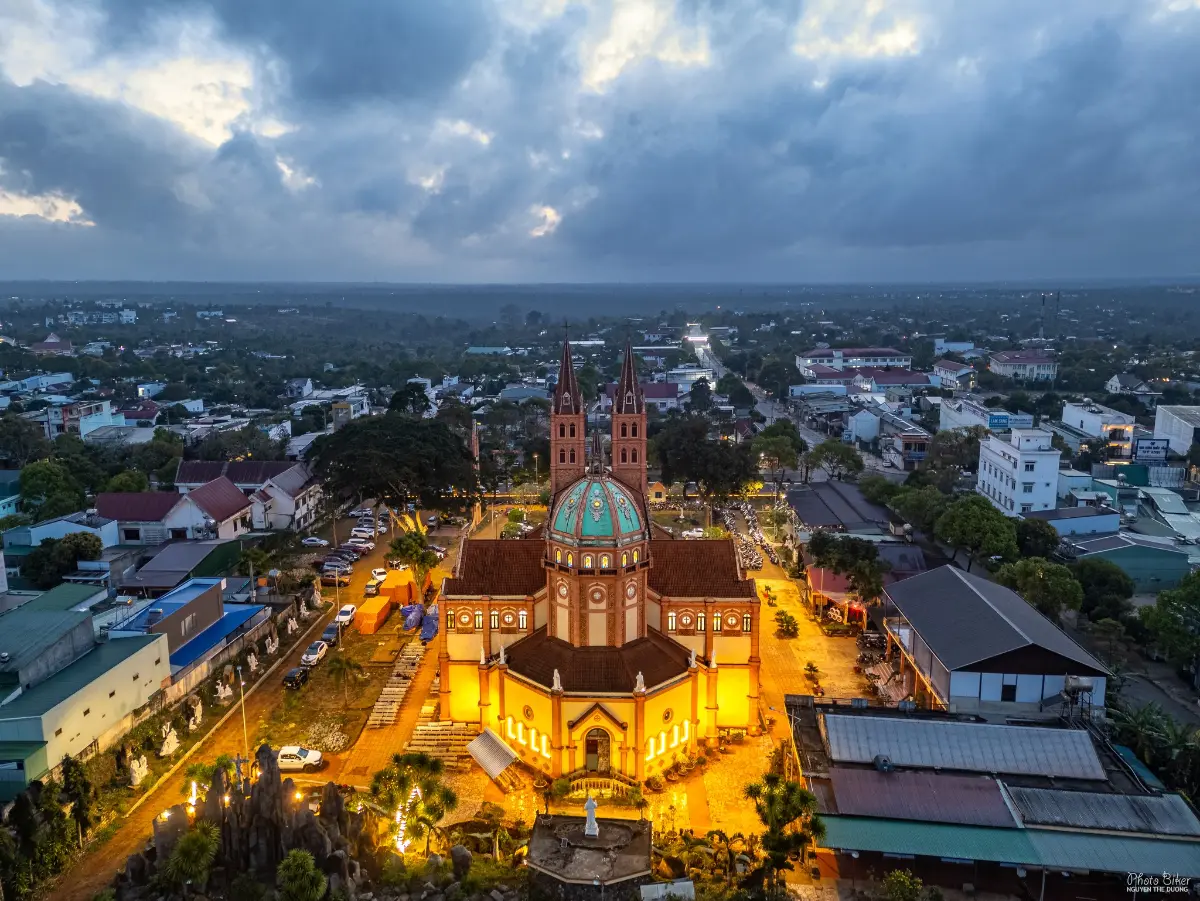
The first thing you notice about Buon Ho Church is its colour. Unlike the grey stone churches of Europe or the whitewashed churches of coastal Vietnam, this cathedral glows a warm, rustic red – the colour of the region’s famous basalt soil and the terracotta bricks fired in local kilns.
From afar, the church’s two bell towers rise toward the sky like “pointed spearheads”. This dual‑tower arrangement is a hallmark of Gothic cathedral design. But far from being a slavish copy of European prototypes, the towers here feel unique: the red brick softens their severity, and their proportions have been subtly adjusted to match the wide, open horizon of the Central Highlands. According to architecture experts, the towers act as a “visual anchor,” making the church visible to anyone travelling along National Highway 14 long before they reach the town centre.
The main entrance features a series of continuous arched doorways – layer after layer of terracotta arches receding inward, creating an illusion of depth and drawing the eye toward the sanctuary. This stacked‑arch motif is pure Gothic, but the warm colour palette and the sturdy, blocky massing feel very much of this place. The overall structure looks “robust”, with architectural blocks that gradually narrow as they climb upward. That upward thrust – a spire pointing to heaven – is another classic Gothic trait. Yet here, the massiveness of the red brick gives the church a grounded, earthy character, as if it grew out of the red soil rather than being dropped onto it.
Most churches in the Central Highlands are built from local wood or stone. A few have whitewashed walls. But Buon Ho’s red hue is almost unique. One travel writer notes that “the distinctive red colour of the building, a rare shade among churches in the Central Highlands, is what gives it its unique appeal.” It symbolises strength and warmth, but helps the structure stand out against the deep green of the surrounding mountains and forests. For Vietnamese travellers, the red evokes another famous cathedral – Saigon’s Notre‑Dame, built from red bricks imported from Marseille. Indeed, many visitors remark on the similarity. “If you’ve ever marvelled at the beauty of Notre Dame Cathedral in Ho Chi Minh City, you’ll notice many interesting similarities when standing before Buon Ho Church,” reports one article. However, the writer adds that this is “not a mere copy, but rather a subtle ‘localisation’.”

Stepping inside Buon Ho Church is like entering another world – one of quiet, solitude and unexpected softness. The sanctuary is covered by a high, wide dome that creates “a distinctive sound and light effect.” Unlike many dark, cavernous Gothic cathedrals in Europe, the interior here feels airy and gentle. The walls are painted in two shades of white and light blue, which prevents the space from feeling heavy or oppressive.
One article notes that this colour choice reduces “the gloomy feeling often found in many classical Gothic buildings.” Instead of inducing awe through weight and shadow, Buon Ho Church invites peace through light and sky‑blue serenity. The result is a space where, according to visitors, one can “easily feel a sense of peace, an emotion difficult to name, but enough to calm the mind amidst the hustle and bustle of life.”
Architecturally, the sanctuary uses pointed arches – another Gothic signature – to frame the altar. These arches direct the eye upward, towards the dome and, symbolically, toward the divine. The use of vertical lines throughout the interior reinforces this upward movement.

The church sits on a hilltop overlooking National Highway 14. The elevated position was likely chosen both for practical reasons (visibility, defence) and symbolic ones (the “city on a hill”). The grounds are spacious and shaded with mature trees. From the hillside, visitors can “gaze into the distance and see a part of the city of Buon Ho, which is developing day by day.” This contrast between the ancient religious architecture and the modern pace of life creates a “harmonious and evocative picture.” During the dry season (November–April), the gardens are pleasant for a picnic or quiet reflection. The red brick of the church, the green of the trees, and the blue of the sky form a perfect tricolour palette for photographers.

Few people who admire the cathedral today know how turbulent its past has been. The story of Buon Ho Church is inseparable from the story of migration and war.
The First Chapel (1965) – A Humble Beginning: Buon Ho parish was officially established in 1960, during a period of upheaval in the Central Highlands. At that time, waves of Catholic refugees were moving south from the central provinces of Quảng Nam, Quảng Ngãi and Bình Định. Fleeing war, they settled in the Buon Ho area. In 1965, Father Nguyễn Đức Hạnh built a small chapel with a wooden frame and a corrugated‑iron roof. It measured only about 100 square metres. Simple as it was, it was enough to nurture the faith of the fledgling community.
The First Stone Church (1970) – A Wartime Effort: In 1967, the Ban Mê Thuột diocese was established. Three years later, on Easter 1970, Bishop Nguyễn Huy Mai laid the foundation stone for the first proper church. Just one year after that (1971), Father Phạm Minh Đức completed the project, using limited materials available during wartime.
The Current Building (2010) – A Community’s Dream Realised: As the parish grew, the old building became too small. After many years of planning and fundraising, in 2008 Bishop Nguyễn Văn Hòa presided over the laying of a new foundation stone. Two years later – in 2010 – Buon Ho Church assumed its current appearance: a majestic Gothic structure covering over 1,200 m², with two bell towers soaring over the highlands. The new building was not merely a replica of the earlier Gothic style; it was a mature expression of what Gothic architecture could become when filtered through the local climate, materials and craftsmanship.
The Meaning of the Name “Buôn Hồ”: The place name “Buôn Hồ” comes from the original village name “Ea Ho” – which in the local language means “village with water flowing from the lake.” Over time, the name was shortened to Buon Ho, and then to Buôn Hồ as the town grew. The church thus carries the memory of the land itself: water, lake, flow – elemental forces that have shaped this region for millennia.
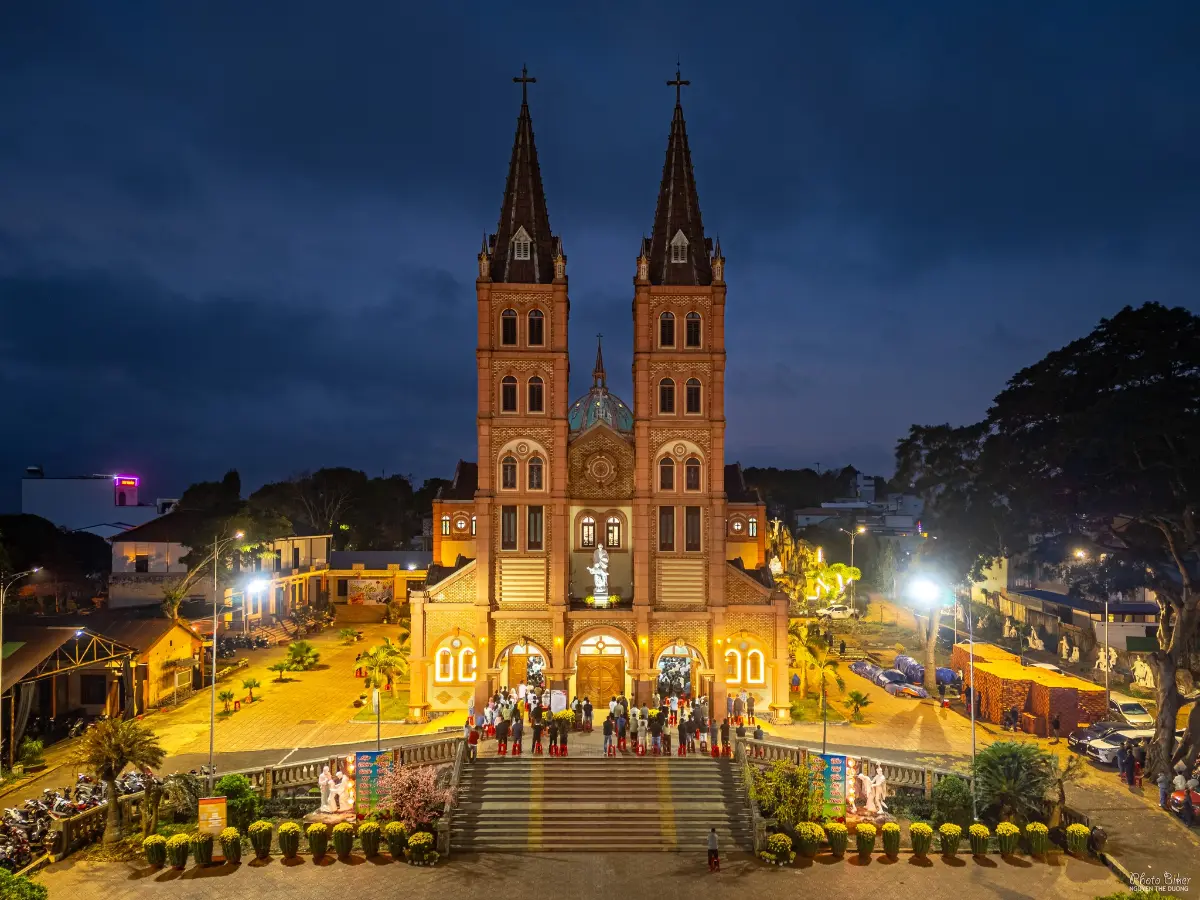
For the Catholic community in Buon Ho, the church is more than a place of worship. It is the very heart of their identity. Many of the parishioners are descendants of the original migrants from the central provinces. They brought with them not only their Catholic faith, but also the memory of their ancestral villages, their local customs, and their resilience in the face of hardship. The church building, built by their own donations and labour, stands as a monument to that resilience.
Beyond the migrant community, the church also serves as a bridge between the Catholic population and the indigenous ethnic groups of the Central Highlands (such as the Ê Đê and Mnông). Though not every villager is Catholic, the church’s hilltop presence has become a landmark for everyone. As one article puts it: “Beyond its architectural value, Buôn Hồ parish church is also a symbol of unity and solidarity among the highland community. From migrants who brought their faith from the sun‑drenched central region, they together built a structure deeply marked by cultural and religious significance.”
| From | Distance | Travel Time | Recommended Transport |
|---|---|---|---|
| Buôn Ma Thuột (airport) | ~50 km | 1 hour by car | Private car, taxi or Grab |
| Đà Lạt | ~200 km | 4–5 hours | Private car or sleeper bus |
| Pleiku | ~180 km | 3.5 hours | Private car |
Road condition: National Highway 14 is well‑paved and offers some of the most scenic mountain driving in Vietnam (coffee plantations on both sides). However, truck traffic can be heavy, so drive carefully.
Public transport: There is no direct bus to Buon Ho Church, but grab a Grab taxi from Buôn Ma Thuột bus station or airport. Some guided tours of Đắk Lắk also include Buon Ho in their itinerary.
| Season | Months | Pros | Cons |
|---|---|---|---|
| Dry | November – April | Clear skies, perfect light, comfortable temperatures | Peak travel season; more crowded |
| Rainy | May – October | Lush greenery, fewer tourists | Muddy roads; chance of afternoon storms |
Best time of day: Early morning (6–8 AM) for the softest light and quietest atmosphere, or late afternoon (3–5 PM) for golden‑hour photography.
What to wear: The church is an active place of worship. Please dress modestly – shoulders and knees covered, remove shoes before entering the sanctuary, turn off or silence mobile phones, speak quietly inside.
Entrance Fee: There is no entrance fee. However, donations for church maintenance are welcome.
| Shot | Location | Best Time |
|---|---|---|
| Full façade with two towers | From the bottom of the hill (looking up) | Morning (7–9 AM) |
| Close‑up of arched doorways | At the main entrance | Any time (the arches shade the entrance) |
| Brick texture detail | Side wall | Mid‑day (highlights the terracotta colour) |
| Interior towards the altar | Centre aisle | Late morning (light streams through windows) |
| Church from distant coffee field | Coffee hill opposite the highway | Golden hour (4–5 PM) |
Pro tip: Use a wide‑angle lens to capture the full height of the bell towers. If you have a drone, check with local authorities first – there are no specific restrictions, but respect privacy around the church.
| Attraction | Distance from Buon Ho | Why Go |
|---|---|---|
| Coffee plantations | Surrounding area (5–20 km) | Taste Vietnam’s best robusta coffee; see the red soil |
| Yok Đôn National Park | ~100 km (2 hours) | Endangered elephants; giant trees; rare birds |
| Buôn Ma Thuột City | ~50 km (1 hour) | Night market; museums; local cuisine (bún đỏ) |
| Lak Lake | ~80 km | Stilt houses; elephant rides on request |
Nhà Thờ Buôn Hồ is proof that architectural beauty is not limited by geography. Here, in the heart of Vietnam’s coffee‑growing highlands, stands a Gothic cathedral built of local red brick and the faith of a migrant community. Its two towers do not imitate Europe – they speak to the sky in a distinctly Vietnamese voice. From its humble corrugated‑iron beginnings to its current status as “the Notre‑Dame of the Central Highlands,” the church embodies the resilience, creativity and devotion of its parishioners. For the traveller, it offers a double gift: a lesson in architectural hybridity and a moment of quiet peace. Whether you are a Catholic pilgrim, a photographer chasing the perfect golden‑hour light, or simply a curious traveller with a taste for the unexpected, Buon Ho Church should be on your Đắk Lắk itinerary.
— The Indochine Chic Team