INDCHINE CHIC · HUE ARCHITECTURAL GUIDE
Indochine Chic Buildings in Hue
Full List of Colonial & Imperial Masterpieces
From the UNESCO-listed Imperial Citadel to French colonial villas along the Perfume River — the complete guide to Hue’s architectural treasures. Every building includes Why It Is Chic, Insider Tip, and Address.

Hue’s architectural heritage — where Nguyen Dynasty grandeur meets French colonial elegance.
Hue is a city of two architectural souls — the majestic Nguyen Dynasty citadels and tombs on one hand, and the elegant French colonial villas and bridges on the other. This unique blend of East and West, imperial and colonial, makes Hue’s architectural heritage unlike anywhere else in Vietnam.
Hue’s Unique Architectural Heritage
As the imperial capital of Vietnam’s last dynasty (1802-1945), Hue was the center of Nguyen Dynasty power. The French colonial period (1885-1954) added another layer — French villas, schools, churches, and a legendary iron bridge designed by Gustave Eiffel. The result is a city where yellow imperial walls stand alongside yellow colonial facades, creating a architectural dialogue unmatched in Vietnam.
📜 Note: This guide includes both Nguyen Dynasty imperial architecture (Citadel, Royal Tombs) and French colonial buildings. All are essential to understanding Hue’s layered history.
Each entry includes: English name (Vietnamese original), year completed, architectural style, historical description, Why It Is Chic, Insider Tip, and full address.
Hue
Hue Imperial Citadel (Imperial City)
(Kinh thành Huế / Đại Nội)
1805 · Nguyễn Dynasty / UNESCO
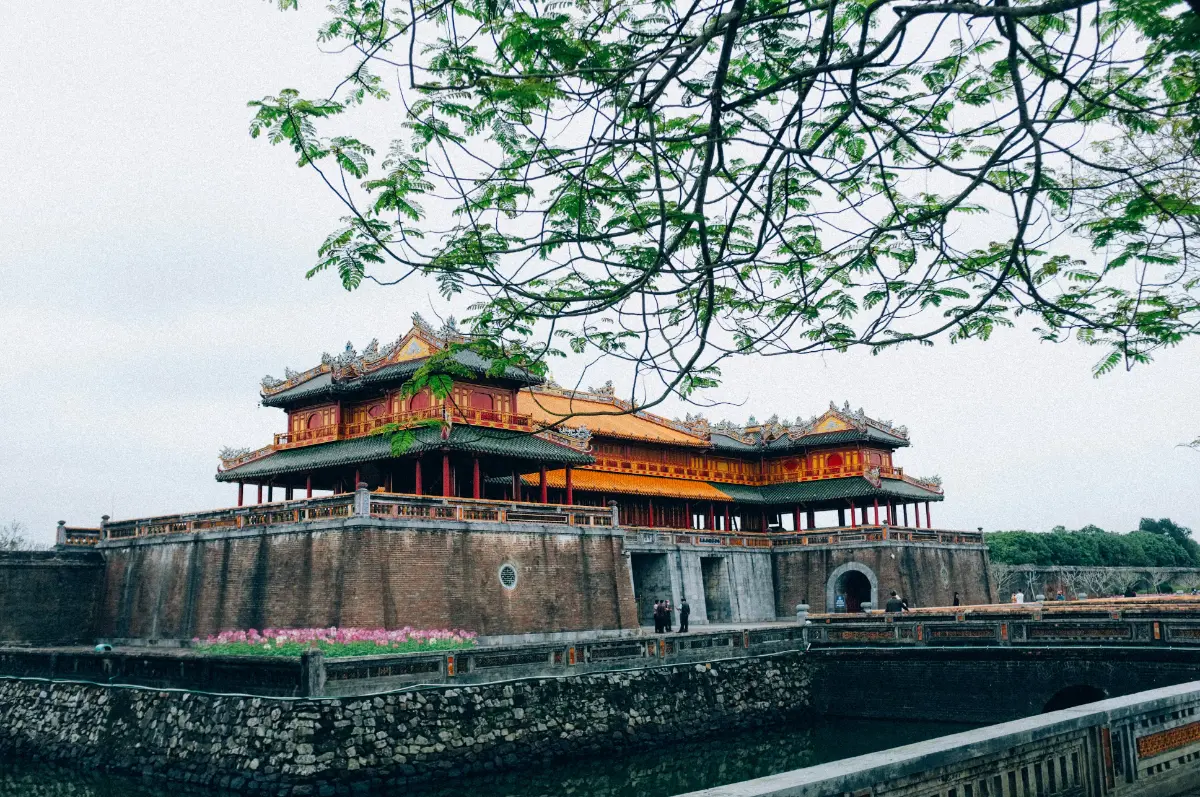
UNESCO World Heritage site. Modeled after Beijing’s Forbidden City, the citadel covers 520 hectares and includes the Flag Tower, Ngo Mon Gate, Thai Hoa Palace, and the Purple Forbidden City.
Why It Is Chic: This is the most complete surviving imperial citadel in Southeast Asia. The Ngo Mon Gate’s five-tiered pavilion, the Thai Hoa Palace’s 80 carved and lacquered pillars, and the Forbidden Purple City’s gardens are masterpieces of traditional Vietnamese architecture. The scale is breathtaking — the citadel is larger than the Forbidden City in Beijing.
Insider Tip: Arrive at 7:30 AM (opening time) to beat the heat and crowds. The Ngo Mon Gate is best photographed at 8 AM when the morning sun illuminates the yellow walls. Entry is approximately $6.50. Allow 3-4 hours minimum. The south gate (Thuận An) is less crowded.
Address: 23 Lê Lợi Street, Hue
Hue
Thien Mu Pagoda (Heavenly Lady Pagoda)
(Chùa Thiên Mụ)
1601 · Nguyễn Dynasty
The seven-story Phuoc Duyen Tower (21 meters) is the iconic symbol of Huế. The pagoda sits on a hill overlooking the Perfume River.
Why It Is Chic: The octagonal seven-story tower is one of the most photographed structures in Vietnam. The pagoda houses the Austin car that carried Thich Quang Duc to his famous self-immolation in Saigon (1963). The setting, on a pine-covered hill above the Perfume River, is sublime. The giant bronze bell, cast in 1710, weighs 2,085 kg and can be heard for 10 kilometers.
Insider Tip: Visit at 4-5 PM for the golden hour light over the Perfume River. The dragon boat ride from the city center (approximately $3) is a lovely approach. The pagoda is free to enter. The car is displayed in a small building behind the main pagoda.
Address: Kim Long Road, Hương Long, Hue (3km west of city center)
Hue
Khai Dinh Tomb
(Lăng Khải Định)
1931 · Gothic / Indochine Blend
The most extravagant of Huế’s royal tombs. Built on a steep hillside, it merges Vietnamese, French, and Gothic styles.
Why It Is Chic: This is the most unique tomb in Vietnam — a flamboyant fusion of European Gothic, Art Deco, and traditional Vietnamese motifs. The facade features 12 stone statues of guardians. The interior is lined with hand-painted porcelain and ceramic mosaics — a stunning, almost psychedelic display of color and pattern. European ironwork and stained glass appear throughout. Emperor Khai Dinh himself described it as “a piece of Europe on Vietnamese soil.”
Insider Tip: The steep staircase (127 steps) is challenging but worth it. Visit in late afternoon (3-4 PM) when the light filters through the stained glass. Entry is approximately $5. The tomb is 12 km south of Hue — hire a car or motorbike.
Address: Châu Chữ Village, Hương Thủy District, Hue (12 km south)
Hue
Tu Duc Tomb
(Lăng Tự Đức)
1867 · Traditional Vietnamese
Set among lotus ponds and pine forests, this is the most romantic and serene of Huế’s royal tombs. The emperor designed it as a retreat.
Why It Is Chic: Unlike the dramatic Khai Dinh Tomb, Tu Duc’s tomb is a study in tranquil elegance. The lake, the pavilion, and the thatched-roof structures create a poetic landscape. The emperor used the complex as a palace retreat while still alive, composing poetry and hunting deer. The tomb itself is surprisingly modest — the emperor was buried elsewhere, secretly, to protect his treasures.
Insider Tip: Visit early morning (7:30-8:30 AM) when the mist rises from the lotus pond. The reflection in the lake is spectacular. Entry is approximately $5. Allow 1.5 hours. The Xung Khiem Pavilion is the best spot for photography.
Address: Thượng Ba Village, Hương Thủy District, Hue (8 km south)
Hue
Minh Mang Tomb
(Lăng Minh Mạng)
1843 · Traditional Vietnamese
The most symmetrical and serene of the royal tombs. Set among pine forest and lotus lakes, with a long avenue of stone statues.
Why It Is Chic: The tomb’s rigorous symmetry and integration with the natural landscape make it a masterpiece of feng shui. The 400-meter avenue is lined with stone elephants, horses, and mandarins. The three courtyard gates open sequentially, revealing the tomb only at the very end. This is Vietnamese imperial architecture at its most harmonious.
Insider Tip: The best time is morning (8-10 AM) when the light is soft. The lotus pond is at its most beautiful in June-July. Entry is approximately $5. Allow 2 hours. Combine with Khai Dinh Tomb for a full morning.
Address: Hương Trà District, Hue (12 km west)
Hue
Quoc Hoc High School (National School)
(Trường Quốc Học Huế)
1896 · French Colonial
One of Vietnam’s most prestigious high schools. Attended by Ho Chi Minh, Võ Nguyên Giáp, and Phạm Văn Đồng. Beautiful colonial buildings set along the Perfume River.
Why It Is Chic: The school’s setting is sublime — yellow colonial buildings shaded by frangipani trees, overlooking the Perfume River. The central building’s arched windows, mansard roof, and clock tower are classic French colonial design. This school educated more Vietnamese leaders than any other institution. The gates still bear the original “Lycée Quốc Học” inscription.
Insider Tip: Walk along the riverbank at sunset (4:30-5:30 PM). The school’s gates are closed to the public, but the exterior is beautiful and worth the stroll. The best view is from the opposite bank of the Perfume River.
Address: 12 Lê Lợi Street, Hue
Hue
Hai Ba Trung School (Dong Khanh School)
(Trường Hai Bà Trưng / Trường Đồng Khánh)
1917 · French Colonial
Formerly Đồng Khánh School, named after a Vietnamese emperor. Later renamed after the Trưng Sisters, legendary Vietnamese heroines.
Why It Is Chic: The building’s elegant yellow facade with green shutters, arched windows, and central pediment is a perfect example of French colonial educational architecture. The school’s name reflects the layered history of Hue — from emperor to revolutionary heroines.
Insider Tip: The school is not open to the public, but the exterior is visible from the street. Best viewed in morning light (8-9 AM).
Address: 1 Lê Lợi Street, Hue
Hue
Hue Railway Station
(Ga Huế)
1906 · French Colonial
Train station on the legendary Reunification Express line. Yellow facade with arched windows and a central clock tower.
Why It Is Chic: The station’s yellow facade, clock tower, and arched windows are beautifully preserved. It is smaller and more intimate than Hanoi or Saigon stations, with a quiet elegance. The station has witnessed the arrival and departure of travelers for over a century, including emperors and revolutionaries.
Insider Tip: Even if not taking a train, visit the station to see the original waiting room with its terrazzo floors and iron columns. The clock tower is best photographed at 4 PM.
Address: 1 Đào Duy Anh Street, Hue
Hue
Saigon Morin Hotel
(Khách sạn Saigon Morin)
1901 · French Colonial
Hue’s most historic hotel. Overlooking the Perfume River. Classic colonial yellow facade with green shutters and a central courtyard.
Why It Is Chic: The Morin has been welcoming guests since 1901, surviving two wars. The hotel’s colonial-era lobby, with its dark wood, vintage photographs, and ceiling fans, is a time capsule. The riverside location is sublime — guests have watched the Perfume River flow past for four generations. The hotel was rebuilt after the 1968 Tet Offensive but preserved its original character.
Insider Tip: Even if not a guest, have a drink in the lobby bar (about $5). The terrace overlooking the river is perfect at sunset. The hotel’s historic photo gallery is free to view.
Address: 30 Lê Lợi Street, Hue
Hue
Trang Tien Bridge (Eiffel Bridge)
(Cầu Tràng Tiền)
1899 · Industrial / Eiffel
Designed by Gustave Eiffel. The iconic bridge over the Perfume River, connecting the Citadel with the French Quarter. Illuminated at night.
Why It Is Chic: The bridge’s delicate steel arch is pure Eiffel — elegant, light, and surprisingly graceful for an industrial structure. The bridge has been rebuilt twice (after storms and wartime damage) but maintains its original silhouette. The bridge changes color at night (purple, blue, green, red) — a modern addition that locals love. It is the symbol of Hue, as recognizable as the Citadel itself.
Insider Tip: Walk across at 6 PM when the sun sets over the Perfume River and the bridge lights up. The view from the Citadel side is best. The pedestrian walkway is safe and wide. For photography, position yourself on the north bank at dusk.
Address: Tràng Tiền Bridge, Hue (crosses Perfume River)
Hue
Redemptorist Church of Hue
(Nhà thờ Dòng Chúa Cứu Thế Huế)
1930s · Neo-Gothic / Romanesque
Redemptorist church with neo-Gothic architecture. Striking twin spires and stained glass windows. One of Hue’s most beautiful churches.
Why It Is Chic: The church’s twin spires (42 meters) dominate the skyline of southern Hue. The facade’s rose window, pointed arches, and stone tracery are classic neo-Gothic, adapted to the tropical climate with wide side windows for ventilation. The interior’s vaulted ceiling and stained glass create a cool, contemplative space.
Insider Tip: Visit during mass (6 AM or 5 PM) to see the interior at its most atmospheric. The best view of the church is from the intersection of Lê Duẩn and Cao Thắng streets.
Address: 1 Cao Thắng Street, Hue
Hue
French Consulate (Former Résident Supérieur Palace)
(Lãnh sự quán Pháp / Dinh Công sứ Pháp cũ)
1910s · French Colonial
Elegant French colonial villa that served as the residence of the French Résident Supérieur, the de facto ruler of Annam. Now the French Consulate.
Why It Is Chic: This villa represents the power of the French colonial administration in central Vietnam. Its neoclassical facade, manicured gardens, and river views were designed to impress — and intimidate. The Résident Supérieur technically advised the Nguyen emperor but held the real power. The building’s architecture reflects that authority.
Insider Tip: The building is not open to the public (active consulate), but the exterior and gardens are visible from the street. The best view is from the opposite bank of the Perfume River.
Address: 7 Nguyễn Tri Phương Street, Hue
Hue
Lau Ngu (Royal Library)
(Lầu Ngự)
1916 · Indochine Blend
A unique building within the Forbidden Purple City that blends traditional Vietnamese architecture with French Art Deco elements.
Why It Is Chic: This is the most visible example of Art Deco influence within the Imperial Citadel — clean lines, geometric patterns, and simplified ornamentation alongside traditional Vietnamese curved roofs and wooden brackets. It is a fascinating hybrid of East and West, built for Emperor Khai Dinh who admired European design.
Insider Tip: The building is inside the Imperial Citadel (ticket required). It is often overlooked by tourists, making it a quiet spot. The interior is not open, but the exterior is beautiful.
Address: Inside the Imperial Citadel, Hue
Hue
An Dinh Palace
(Cung An Định)
1917 · French Beaux-Arts / Art Deco
A European-style palace built by Emperor Khai Dinh. The facade is pure French Beaux-Arts with statues of Roman goddesses.
Why It Is Chic: This palace is shockingly European — the facade features statues of Roman goddesses, wrought-iron balconies, and a mansard roof. The interior’s throne room is decorated with exquisite ceramic mosaics and stained glass. This was the personal residence of the emperor, where he could indulge his love for European style away from the traditional court.
Insider Tip: The palace is often empty of tourists. The ceramic mosaic interiors are spectacular. Entry is approximately $3. The palace is a 10-minute drive from the Citadel. Allow 45 minutes.
Address: 89 Nguyễn Hoàng Road, Hue
Hue
Dieu De Pagoda (Imperial Pagoda)
(Chùa Diệu Đế)
1844 · Nguyễn Dynasty
A royal pagoda built by Emperor Thiệu Trị. The three-arched gate and octagonal tower are fine examples of Nguyen Dynasty architecture.
Why It Is Chic: The pagoda’s three-arched gate is one of the most photographed in Hue. The octagonal tower (Từ Nhân Tower) rises 21 meters. The complex is less crowded than Thien Mu Pagoda, offering a more peaceful experience. The pagoda served as the headquarters of the Buddhist Struggle Movement in the 1960s.
Insider Tip: Visit early morning (7-8 AM) when the monks are chanting. The pagoda is free. It is located near the Citadel, making it easy to combine with a morning visit.
Address: 121 Đặng Thái Thân Street, Hue
Hue
Khai Thanh Pavilion (Art Deco Royal Pavilion)
(Khải Thành Pavilion)
1920s · Art Deco / Indochine
A small but exquisite Art Deco pavilion within the Forbidden Purple City, built by Emperor Khai Dinh.
Why It Is Chic: This tiny pavilion is a perfect example of Indochine Art Deco — geometric patterns, clean lines, and tropical adaptation. The stained glass windows depict both European and Vietnamese motifs. It is a hidden gem within the Citadel.
Insider Tip: The pavilion is inside the Imperial Citadel. Most tours skip it, so you may have it to yourself. Best photographed in late afternoon light.
Address: Inside the Imperial Citadel, Hue
Hue
Provincial Museum of Thua Thien Hue (Former French Governor’s Palace)
(Bảo tàng Văn hóa Huế / Dinh Công sứ cũ)
1910s · French Colonial
Former residence of the French governor of Thua Thien province. Now a museum of local history and culture.
Why It Is Chic: The building’s elegant colonial architecture — yellow facade, green shutters, arched windows — is beautifully preserved. The museum’s collection includes photographs of colonial-era Hue, French furniture, and artifacts from the imperial court.
Insider Tip: Entry is approximately $1. The museum is small but charming. The garden behind the building is a quiet spot for a rest.
Address: 5 Lê Lợi Street, Hue
Hue
French Quarter Villas (Lê Lợi – Trần Hưng Đạo Area)
(Khu biệt thự Pháp cổ)
1910s-1930s · French Colonial
A collection of beautifully preserved French colonial villas along Lê Lợi Street, Trần Hưng Đạo Street, and surrounding lanes.
Why It Is Chic: This neighborhood of yellow villas with green shutters, mansard roofs, and wrought-iron balconies is the most intact French colonial residential area in Hue. Wandering these streets feels like stepping back a century. Many villas are still inhabited; others have been converted into cafes and galleries.
Insider Tip: Walk along Lê Lợi Street at 4 PM when the light is golden. Many villas are now cafes — stop for coffee at one (Le Petit Carp is recommended). The area is best explored on foot.
Address: Lê Lợi Street, Trần Hưng Đạo Street, Hue
Hue
Hue High School for the Gifted (Former College de Hue)
(Trường THPT Chuyên Quốc Học)
1920s · French Colonial
Another beautiful French colonial school building, adjacent to Quoc Hoc High School.
Why It Is Chic: The building’s yellow facade, central clock tower, and arched windows are classic French colonial design. The school has educated generations of Hue’s elite.
Insider Tip: The exterior is best viewed from Lê Lợi Street. Combine with a walk to nearby Quoc Hoc High School.
Address: 14 Lê Lợi Street, Hue
Hue
British Embassy Compound (Former French Colonial Villa)
(Đại sứ quán Anh / Biệt thự Pháp cũ)
1920s · French Colonial
An elegant French colonial villa now serving as the British Embassy compound.
Why It Is Chic: This villa is a perfect example of a grand French colonial residence — imposing yellow facade, manicured gardens, and a sweeping driveway. The building’s symmetrical proportions and wrought-iron details are beautifully preserved.
Insider Tip: The building is not open to the public, but the exterior is visible from the street. Best viewed from the opposite side of Lê Lợi Street.
Address: 1 Lê Lợi Street, Hue
Summary: Hue’s Architectural Heritage
Top 7 Must-See: Imperial Citadel | Khai Dinh Tomb | Thien Mu Pagoda | Trang Tien Bridge | Tu Duc Tomb | Saigon Morin Hotel | Quoc Hoc High School
Best Walking Route: Start at Imperial Citadel (7:30 AM) → walk along Perfume River to Trang Tien Bridge → continue to French Quarter villas on Lê Lợi Street → end at Saigon Morin Hotel for sunset drinks. Total distance: 3 km, about 3 hours with stops.
Transport Tips: The royal tombs are scattered south of the city (8-12 km). Hire a car ($30/day), motorbike ($8/day), or take a dragon boat on the Perfume River ($15 for 2-hour tour).
Photography Tips: Trang Tien Bridge at 6 PM (sunset + illumination). Imperial Citadel at 8 AM (morning light on Ngo Mon Gate). Khai Dinh Tomb at 3-4 PM (light through stained glass).
Chicly yours, The Indochine Chic Team
*All information verified April 2026. Entry fees: Imperial Citadel $6.50, Royal Tombs $5 each. Many buildings are active government, religious, or educational sites — dress respectfully. The Imperial Citadel requires modest attire.*
Indochine Chic Buildings in Hue — Full list of imperial and colonial masterpieces with Why It Is Chic, Insider Tips, and Addresses. · © 2026 Indochine Chic — Journey into elegance.