INDCHINE CHIC · COMPLETE ARCHITECTURAL PILLAR GUIDE
75 Indochine Chic Buildings in Vietnam
The definitive guide to every must-see colonial masterpiece — from Hanoi to Saigon, Da Lat to Hue. English names with Vietnamese originals, history, styles, and addresses.

The timeless elegance of Indochine architecture — from north to south. 75 buildings documented with English and Vietnamese names.
Indochine architecture is not merely French with tropical adjustments. It is a dialogue — between wrought iron and wooden shutters, between Versailles and the Mekong, between a European longing for order and the Vietnamese love for light and air. This guide documents 75 of the finest surviving examples across Vietnam, presented with English names and Vietnamese originals.
What Makes Indochine Architecture So Chic?
Indochine architecture emerged during French colonial rule (1887–1954), but it was never a simple import. French architects adapted to Vietnam’s tropical climate — adding deep verandas, louvered shutters, high ceilings, cross-ventilation, and terracotta tile floors. They blended Beaux-Arts grandeur with Vietnamese materials: teakwood, local stone, and handmade bricks. The result is buildings that breathe, that shade, that feel both European and utterly Vietnamese.
The signature elements of Indochine style include: yellow-painted plaster facades (the famous “colonial yellow”), green wooden shutters, wrought-iron balconies with floral motifs, high ceilings (typically 4-5 meters) with ceiling fans, large arched windows for airflow, and terracotta roof tiles. Today, these buildings are not historical relics locked behind glass — they are functioning landmarks that continue to serve the public while embodying timeless chic.
Hanoi — 25 Indochine Masterpieces
Hanoi
Presidential Palace
(Phủ Chủ tịch / Phủ Toàn quyền Đông Dương)
1906 · French Colonial
Former Palace of the Governor-General of French Indochina. Now the Presidential Palace, set amid sprawling gardens and the famous Ho Chi Minh’s stilt house. The mustard-yellow facade, mansard roof, and Ionic columns exemplify French Beaux-Arts grandeur.
Hanoi
Hanoi Opera House
(Nhà hát Lớn Hà Nội)
1911 · Beaux-Arts
Modeled after Paris’s Palais Garnier, this is the crown jewel of French colonial architecture in Southeast Asia. Its copper-green dome, Ionic columns, and arched windows have hosted generations of artists. Night performances available.
Hanoi
St. Joseph’s Cathedral
(Nhà thờ Lớn Hà Nội / Nhà thờ Thánh Joseph)
1886 · Neo-Gothic
Resembles Notre-Dame de Paris with twin bell towers reaching 31 meters, pointed arches, and rose windows. Bricks were imported from France. Sunday mass at 9:30 AM features a Latin choir.
Hanoi
Long Biên Bridge
(Cầu Long Biên / Cầu Doumer)
1902 · Industrial / Eiffel
Designed by Gustave Eiffel, this 2.5-kilometer cantilever bridge was the first steel bridge across the Red River. Survived wartime bombing; damaged sections left as memorial. Sunset walks are iconic.
Hanoi
Hanoi Central Post Office
(Bưu điện Hà Nội / Bưu điện Bờ Hồ)
1894 · French Colonial
Overlooking Hoan Kiem Lake, this yellow post office features arched windows, a central clock, and wrought-iron detailing. Still functioning, it’s a beloved meeting point for Hanoians.
Hanoi
Hanoi Railway Station
(Ga Hà Nội / Ga Hàng Cỏ)
1902 · French Colonial
The original station building features a yellow facade with arched windows. From here, the Reunification Express departs for the 1,726-kilometer journey to Saigon.
Hanoi
Sofitel Legend Metropole Hanoi
(Khách sạn Sofitel Legend Metropole Hà Nội)
1901 · French Colonial
Legendary hotel where Graham Greene wrote “The Quiet American” and Charlie Chaplin honeymooned. The Heritage Wing preserves original architecture. Historical tours available.
Hanoi
National Museum of Vietnamese History
(Bảo tàng Lịch sử Quốc gia / Viện Viễn Đông Bác cổ)
1932 · Indochine Blend
Formerly the Louis Finot Museum of the École Française d’Extrême-Orient. Blends French Beaux-Arts with Vietnamese pagoda motifs. Houses 200,000 artifacts.
Hanoi
Ministry of Foreign Affairs
(Trụ sở Bộ Ngoại giao / Sở Tài chính Đông Dương)
1925 · Neoclassical
Imposing colonnaded facade with allegorical sculptures. Originally the Indochina Finance Department, now Vietnam’s Ministry of Foreign Affairs.
Hanoi
Hanoi University (Indochina University)
(Đại học Tổng hợp Hà Nội / Đại học Đông Dương)
1926 · French Colonial
The former Indochina University. Grand staircase, arched windows, and central courtyard. Now part of Hanoi National University.
Hanoi
Supreme People’s Court (Palace of Justice)
(Tòa án Nhân dân Tối cao / Tòa án Công lý)
1930 · Beaux-Arts
Former Palace of Justice. Symmetrical facade with Corinthian columns and blind arches. Still functioning as the Supreme People’s Court.
Hanoi
State Bank of Vietnam (Bank of Indochina)
(Ngân hàng Nhà nước Việt Nam / Ngân hàng Đông Dương)
1925 · Neoclassical
Former Bank of Indochina. Features a breathtaking stained-glass ceiling and marble floors. A functioning bank, but lobby accessible during business hours.
Hanoi
Hoa Lo Prison (Maison Centrale)
(Nhà tù Hỏa Lò / Maison Centrale)
1896 · Prison architecture
Built by the French to house political prisoners, later used by North Vietnam for American POWs (including John McCain). Now a museum documenting colonial-era incarceration.
Hanoi
Dong Xuan Market
(Chợ Đồng Xuân)
1889 · French Colonial
Hanoi’s largest indoor market, rebuilt after a 1994 fire but preserving its French-designed facade. Three arched entryways and a central clock tower.
Hanoi
Hang Dau Water Tower
(Tháp nước Hàng Đậu)
1894 · Industrial Gothic
One of Hanoi’s earliest water towers. Cylindrical brick structure with Gothic-inspired crenellations. No longer in use, but preserved as a landmark.
Hanoi
Phan Dinh Phung Water Tower
(Tháp nước Phan Đình Phùng)
1920s · Industrial
A striking cylindrical water tower at the intersection of Phan Đình Phùng and Hoàng Diệu streets. Built to serve the French Quarter’s water needs.
Hanoi
Vietnam National Library
(Thư viện Quốc gia Việt Nam)
1919 · French Colonial
Formerly the Indochina National Library. Yellow facade, arched windows, and a grand reading room with original chandeliers.
Hanoi
Nhan Dan Newspaper Headquarters (Former Electricity Department)
(Trụ sở Báo Nhân Dân / Sở Điện lực cũ)
1920s · French Colonial
Former Electricity Department building. Later became headquarters of Nhân Dân newspaper. Yellow facade with green shutters.
Hanoi
Chu Van An High School (Lycee du Protectorat)
(Trường THPT Chu Văn An / Trường Bưởi)
1908 · French Colonial
Formerly Lycée du Protectorat. One of Hanoi’s oldest high schools, attended by generations of Vietnamese elites. Elegant colonial architecture with shaded courtyards.
Hanoi
Phan Dinh Phung High School (Lycée des Jeunes Filles)
(Trường THPT Phan Đình Phùng)
1920s · French Colonial
Formerly Lycée des Jeunes Filles. Beautifully preserved school with yellow walls, wooden shutters, and a central garden.
Hanoi
Tran Phu High School (Petit Lycée de Hanoi)
(Trường THPT Trần Phú / Trường Petit Lycée)
1920s · French Colonial
Former Petit Lycée de Hanoi. Intimate scale compared to other colonial schools. Now a specialized high school for gifted students.
Hanoi
Viet Duc High School (Puginier Boarding School)
(Trường THPT Việt Đức / Trường dòng Puginier)
1890s · Neo-Gothic
Formerly a Catholic boarding school run by the Puginier brothers. Distinctive red brick and neo-Gothic chapel windows.
Hanoi
Villa at 65 Nguyen Thai Hoc Street
(Biệt thự số 65 Nguyễn Thái Học)
1920s · French Colonial
One of the best-preserved French villas in Hanoi. Yellow facade, green shutters, wrought-iron balconies, and a mansard roof. Now a cultural center.
Hanoi
Government Guest House (Tonkin Palace)
(Nhà khách Chính phủ / Bắc Bộ Phủ)
1918 · French Colonial
Former Palace of the Tonkin Governor (Bắc Bộ Phủ). Used for government receptions. Elegant colonial architecture with a grand staircase.
Hanoi
National Institute of Hygiene and Epidemiology (Pasteur Institute)
(Viện Vệ sinh Dịch tễ Trung ương / Viện Pasteur)
1920s · French Colonial
Part of the Pasteur Institute network founded by Alexandre Yersin. Research facility with preserved colonial laboratory buildings.
Ho Chi Minh City (Saigon) — 19 Indochine Masterpieces
Saigon
Notre-Dame Cathedral Basilica of Saigon
(Nhà thờ Đức Bà Sài Gòn)
1880 · Romanesque / Neo-Gothic
All red bricks imported from Marseille. Twin bell towers rise 58 meters. Stained glass from Chartres. Sunday mass at 9:30 AM with Latin choir.
Saigon
Saigon Central Post Office
(Bưu điện Trung tâm Sài Gòn)
1891 · Gothic / Renaissance
Designed by Gustave Eiffel. Features a 50-meter arched ceiling, antique telephone booths, and 1892 maps of Saigon. A working post office.
Saigon
Ho Chi Minh City Hall (Hôtel de Ville)
(Trụ sở UBND TP.HCM / Dinh Xã Tây)
1908 · French Colonial
Former Hôtel de Ville (City Hall). One of Saigon’s most photographed facades. Illuminated at night. Statue of Uncle Ho in front.
Saigon
Saigon Opera House (Opéra de Saigon)
(Nhà hát Thành phố)
1900 · Beaux-Arts
Smaller than Hanoi but more ornate, with floral reliefs and a curving staircase. Now hosts the AO Show and cultural events.
Saigon
Ho Chi Minh City Museum (Gia Long Palace)
(Bảo tàng Thành phố Hồ Chí Minh / Dinh Gia Long)
1885 · French Colonial
Former Gia Long Palace. Elegant neoclassical villa with wrought-iron gates and shaded gardens. Now the City Museum.
Saigon
Ho Chi Minh City Fine Arts Museum
(Bảo tàng Mỹ thuật TP.HCM / Dinh thự Chú Hỏa)
1929 · Art Deco / Colonial
A stunning Art Deco villa built by a wealthy Chinese-Vietnamese merchant. Now houses Vietnam’s finest collection of modern and contemporary art.
Saigon
Museum of Vietnamese History (Blanchard de la Brosse Museum)
(Bảo tàng Lịch sử TP.HCM / Viện Bảo tàng Blanchard de la Brosse)
1929 · Indochine / Orientalist
Blends French Beaux-Arts with Vietnamese pagoda motifs. Collection includes Cham sculpture and Nguyen dynasty artifacts.
Saigon
Ho Chi Minh City People’s Court (Palace of Justice)
(Tòa án Nhân dân TP.HCM)
1885 · French Colonial
Former Palace of Justice. Imposing neoclassical facade with Corinthian columns. Still functioning as the city’s courthouse.
Saigon
Continental Hotel Saigon
(Khách sạn Continental Saigon)
1880 · French Colonial
Where Graham Greene wrote “The Quiet American.” Green shutters, wrought-iron balconies. Café de la Musique unchanged since 1880.
Saigon
Majestic Hotel Saigon
(Khách sạn Majestic Saigon)
1925 · French Colonial
Overlooking Saigon River. Rooftop bar with stunning night views. The first hotel in Saigon with elevators and air conditioning.
Saigon
Grand Hotel Saigon
(Khách sạn Grand Hotel Saigon)
1930 · French Colonial
Located on Đồng Khởi Street. Classic colonial yellow facade with arched windows and a central courtyard.
Saigon
Ben Thanh Market
(Chợ Bến Thành)
1914 · French Colonial
Saigon’s most famous market. The clock tower and arched entrances are iconic symbols of the city. Open daily from 7 AM to 7 PM.
Saigon
Nha Rong Harbor (Messageries Maritimes Building)
(Bến Nhà Rồng / Trụ sở Công ty Vận tải Đường biển Messageries Maritimes)
1863 · French Colonial
Where young Nguyen Tat Thanh (later Ho Chi Minh) worked as a cook and departed for France in 1911. Now the Ho Chi Minh Museum.
Saigon
Le Quy Don High School (Chasseloup-Laubat School)
(Trường THPT Lê Quý Đôn / Trường Chasseloup-Laubat)
1874 · French Colonial
One of Saigon’s oldest high schools. Named after a French naval minister. Elegant colonial architecture with a central courtyard.
Saigon
Nguyen Thi Minh Khai High School (Gia Long School)
(Trường THPT Nguyễn Thị Minh Khai / Trường Gia Long)
1913 · French Colonial
Formerly Lycée Gia Long, the first French high school for girls in Indochina. Beautifully preserved with yellow walls and arched windows.
Saigon
University of Medicine and Pharmacy (Old Campus)
(Đại học Y Dược TP.HCM / Cơ sở cũ)
1920s · French Colonial
Former medical school built by the French. Classic colonial architecture with high ceilings and shaded corridors.
Saigon
Hanh Thong Tay Pagoda (Franco-Vietnamese Architecture)
(Chùa Hạnh Thông Tây)
1920s · Indochine Blend
A unique Buddhist pagoda that incorporates French colonial elements — arched windows and tiled floors alongside traditional Vietnamese altar and roof.
Saigon
Rainbow Bridge (Messageries Maritimes Bridge)
(Cầu Mống / Cầu Messageries Maritimes)
1882 · Industrial / Eiffel
An Eiffel-designed steel bridge over the Bến Nghé Canal. The name means “Rainbow Bridge” in Vietnamese. One of Saigon’s oldest bridges.
Saigon
French Consulate General (Former Governor of Cochinchina Palace)
(Tổng lãnh sự quán Pháp / Dinh Thống đốc Nam Kỳ cũ)
1873 · French Colonial
Former Palace of the Governor of Cochinchina. Now the French Consulate General. An elegant neoclassical villa set amid gardens.
Da Lat — 13 Indochine Masterpieces
Da Lat
Da Lat Railway Station
(Ga Đà Lạt)
1938 · Art Deco / Indochine
One of Vietnam’s most beautiful buildings. Three gables inspired by Lang Biang mountain. Stained glass windows. An old steam locomotive is preserved on site.
Da Lat
Da Lat Pedagogical College (Grand Lycée Yersin)
(Trường Cao đẳng Sư phạm Đà Lạt / Trường Grand Lycée Yersin)
1927 · French Colonial
Formerly Grand Lycée Yersin, named after Dr. Alexandre Yersin, founder of Da Lat. Elegant school buildings set among pine trees.
Da Lat
Bao Dai Palace I
(Dinh I Bảo Đại)
1940 · Art Deco
The first of three villas owned by Emperor Bảo Đại. Located on a hill overlooking Da Lat. Art Deco lines and original furnishings.
Da Lat
Bao Dai Palace II (Governor-General Palace)
(Dinh II Bảo Đại / Dinh Toàn quyền)
1930s · French Colonial
Originally built for the French Governor-General. Later served as a summer residence for Bảo Đại. Now a museum.
Da Lat
Bao Dai Palace III
(Dinh III Bảo Đại)
1933 · Art Deco / Colonial
The emperor’s primary summer residence. Three-story villa with a grand staircase, library, and original furnishings. Balconies offer sweeping pine forest views.
Da Lat
Da Lat Cathedral (Chicken Church)
(Nhà thờ Chính tòa Đà Lạt / Nhà thờ Con Gà)
1942 · Romanesque Revival
Named for the rooster weathervane on its 47-meter spire. Pink brick exterior. Stained glass windows imported from France.
Da Lat
Domaine de Marie Church
(Nhà thờ Domaine de Marie)
1940 · French Colonial
A convent and orphanage on a hill. Red brick church with a unique curved roof and rose garden. Nuns still live here.
Da Lat
Dalat Palace Hotel (Langbiang Palace)
(Khách sạn Dalat Palace / Langbiang Palace)
1922 · French Colonial
Da Lat’s most luxurious historic hotel. Overlooking Xuan Huong Lake. Restored to its original grandeur with antique furnishings and a renowned wine cellar.
Da Lat
Du Parc Hotel
(Khách sạn Du Parc)
1932 · Art Deco
A charming Art Deco hotel near the cathedral. The lobby features original tile work and a grand staircase.
Da Lat
Tran Le Xuan Villa (Madame Nhu’s Villa)
(Biệt điện Trần Lệ Xuân)
1950s · Colonial villa
Private villa belonging to Trần Lệ Xuân (Madame Nhu), First Lady of South Vietnam (1955-1963). Secluded hilltop location.
Da Lat
Pasteur Institute of Da Lat
(Viện Pasteur Đà Lạt)
1936 · French Colonial
Part of the Pasteur Institute network founded by Alexandre Yersin. Research facility with preserved colonial laboratory buildings.
Da Lat
Tay Nguyen Institute of Biology (Former Redemptorist Monastery)
(Viện Sinh học Tây Nguyên / Dòng Chúa Cứu Thế cũ)
1940s · French Colonial
Former Redemptorist monastery. Now the Tay Nguyen Institute of Biology. Preserved colonial architecture with a chapel.
Da Lat
Minh Hoa Seminary
(Chủng viện Minh Hòa)
1950s · French Colonial
A Catholic seminary with elegant colonial architecture, set amid Da Lat’s signature pine forests.
Haiphong — 5 Indochine Masterpieces
Haiphong
Haiphong Opera House
(Nhà hát Lớn Hải Phòng)
1912 · Neoclassical
Smaller, intimate sister to Hanoi’s Opera House. Copper-green dome, original chandeliers, and beautiful plasterwork. Blissfully uncrowded.
Haiphong
Haiphong Railway Station
(Ga Hải Phòng)
1902 · French Colonial
Terminus of the Reunification Express line. Yellow facade with arched windows. The original station building remains in use.
Haiphong
Haiphong Museum (Former Franco-Chinese Bank)
(Bảo tàng Hải Phòng / Ngân hàng Pháp – Hoa cũ)
1920s · French Colonial
Former Franco-Chinese bank. Now the Hai Phòng Museum. Elegant colonial architecture housing artifacts from the French colonial era.
Haiphong
Haiphong Central Post Office
(Bưu điện Trung tâm Hải Phòng)
1900s · French Colonial
Central post office of Haiphong. Yellow facade with arched windows and a central clock. Still functioning.
Haiphong
State Bank of Vietnam Haiphong Branch (Former Bank of Indochina)
(Ngân hàng Nhà nước chi nhánh Hải Phòng / Ngân hàng Đông Dương cũ)
1920s · Neoclassical
Former Bank of Indochina branch. Imposing neoclassical facade with columns. Now the State Bank of Vietnam’s Haiphong branch.
Hue — 6 Indochine Masterpieces
Hue
Quoc Hoc High School
(Trường Quốc Học Huế)
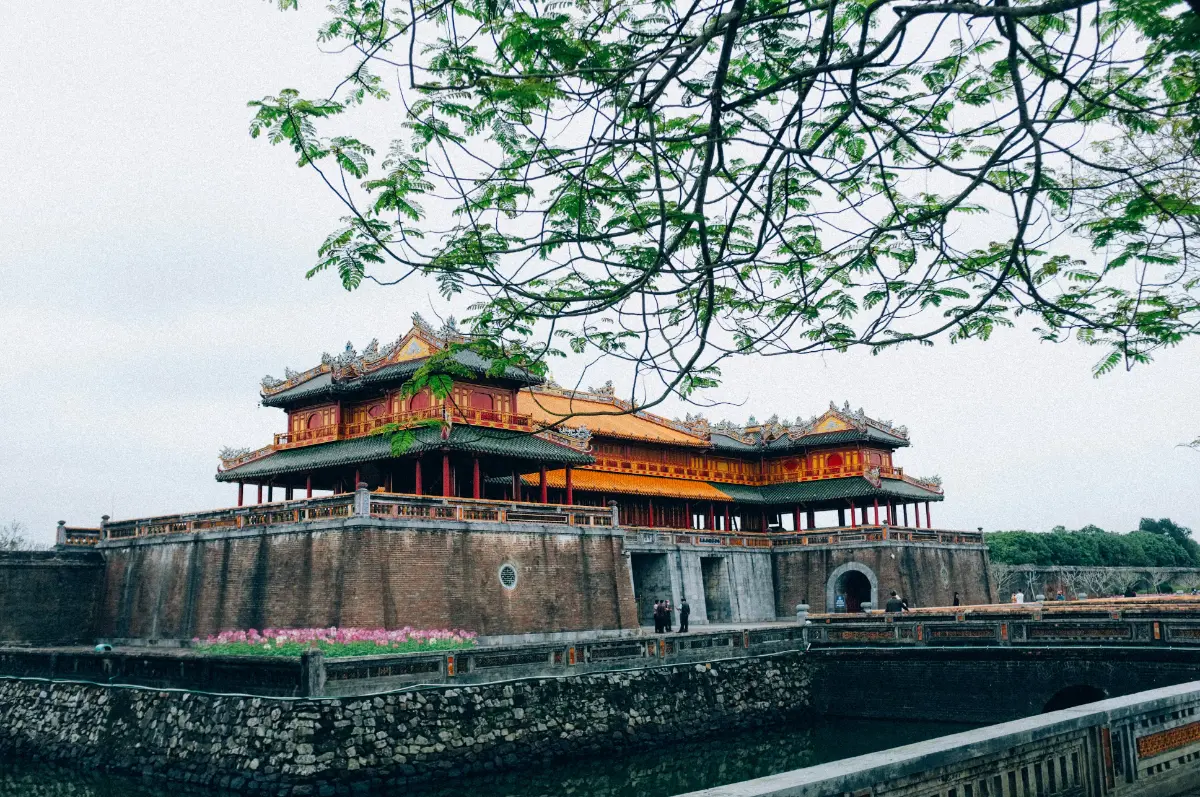
1896 · French Colonial
One of Vietnam’s most prestigious high schools. Attended by Ho Chi Minh, Võ Nguyên Giáp, and Phạm Văn Đồng. Beautiful colonial buildings set along the Perfume River.
Hue
Hai Ba Trung School (Dong Khanh School)
(Trường Hai Bà Trưng / Trường Đồng Khánh)
1917 · French Colonial
Formerly Đồng Khánh School, named after a Vietnamese emperor. Later renamed after the Trưng Sisters. Now a cultural landmark.
Hue
Hue Railway Station
(Ga Huế)
1906 · French Colonial
Train station on the Reunification Express line. Yellow facade with arched windows and a central clock tower. Beautifully preserved.
Hue
Saigon Morin Hotel
(Khách sạn Saigon Morin)
1901 · French Colonial
Hue’s most historic hotel. Overlooking the Perfume River. Classic colonial yellow facade with green shutters and a central courtyard.
Hue
Trang Tien Bridge (Eiffel Bridge)
(Cầu Tràng Tiền / Thiết kế bởi hãng Eiffel)
1899 · Industrial / Eiffel
Designed by Gustave Eiffel. The iconic bridge over the Perfume River, connecting the Citadel with the French Quarter. Illuminated at night.
Hue
Redemptorist Church of Hue
(Nhà thờ Dòng Chúa Cứu Thế Huế)
1930s · Neo-Gothic
Redemptorist church with neo-Gothic architecture. Striking twin spires and stained glass windows. One of Hue’s most beautiful churches.
Other Provinces — 7 Indochine Masterpieces
Da Nang
Da Nang Cathedral (Chicken Church)
(Nhà thờ Chính tòa Đà Nẵng / Nhà thờ Con Gà)
1923 · Gothic Revival
Known as Chicken Church for the rooster weathervane. Pink facade, pointed arches, and stained glass. The oldest Catholic church in Da Nang.
Da Nang
Museum of Cham Sculpture
(Bảo tàng Điêu khắc Chăm Đà Nẵng)
1915 · French Colonial
The world’s largest collection of Cham art, housed in a beautiful yellow colonial building. Founded by the École Française d’Extrême-Orient.
Da Nang
Old Da Nang City Hall (Former City Council)
(Tòa thị chính cũ Đà Nẵng / Hội đồng Thành phố cũ)
1920s · French Colonial
Former city hall of colonial Da Nang (then known as Tourane). Yellow facade overlooking the Han River.
Nam Dinh
Phu Nhai Church
(Nhà thờ Phú Nhai)
1933 · Neo-Gothic
One of Vietnam’s most magnificent churches. Twin spires rise 55 meters. Blends European Gothic with Vietnamese decorative motifs. Renovated after a 2020 fire.
Hai Duong
Ke Sat Church
(Nhà thờ Kẻ Sặt)
1890s · Neo-Gothic
A beautiful brick church in the heart of Hải Dương province. Pointed arches, rose window, and a peaceful garden setting.
Nghe An
Xa Doai Bishop’s House
(Tòa Giám mục Xã Đoài)
1930s · French Colonial
The bishop’s residence in Xã Đoài village. Elegant colonial architecture set amid rural Nghệ An.
Kon Tum
Kon Tum Wooden Church (Romanesque-Stilt House Blend)
(Nhà thờ Gỗ Kon Tum)
1913 · Romanesque / Stilt house
A unique wooden church blending Romanesque architecture with traditional Bahnar stilt house construction. Built entirely of wood without nails. A masterpiece of cultural fusion.
Final Verdict: Vietnam’s 75 Indochine Masterpieces
These 75 buildings represent the finest surviving examples of Indochine architecture in Vietnam. They have survived wars, revolutions, and neglect, and many have been lovingly restored. They continue to serve their communities — as churches, schools, hotels, museums, and government buildings. Whether you have a week or a month, this list will guide you to the most beautiful expressions of Indochine chic. Pack comfortable walking shoes, bring a camera, and let the yellow walls and green shutters transport you to an era of elegance that never truly ended — it merely evolved.
Chicly yours, The Indochine Chic Team
*All buildings listed are open to the public or visible from public spaces. Entry fees vary (most under $3 USD). Information verified April 2026.*
75 Indochine Chic Buildings in Vietnam — The complete architectural directory with English and Vietnamese names. · © 2026 Indochine Chic — Journey into elegance.