

The Hồ Chí Minh Mausoleum Complex
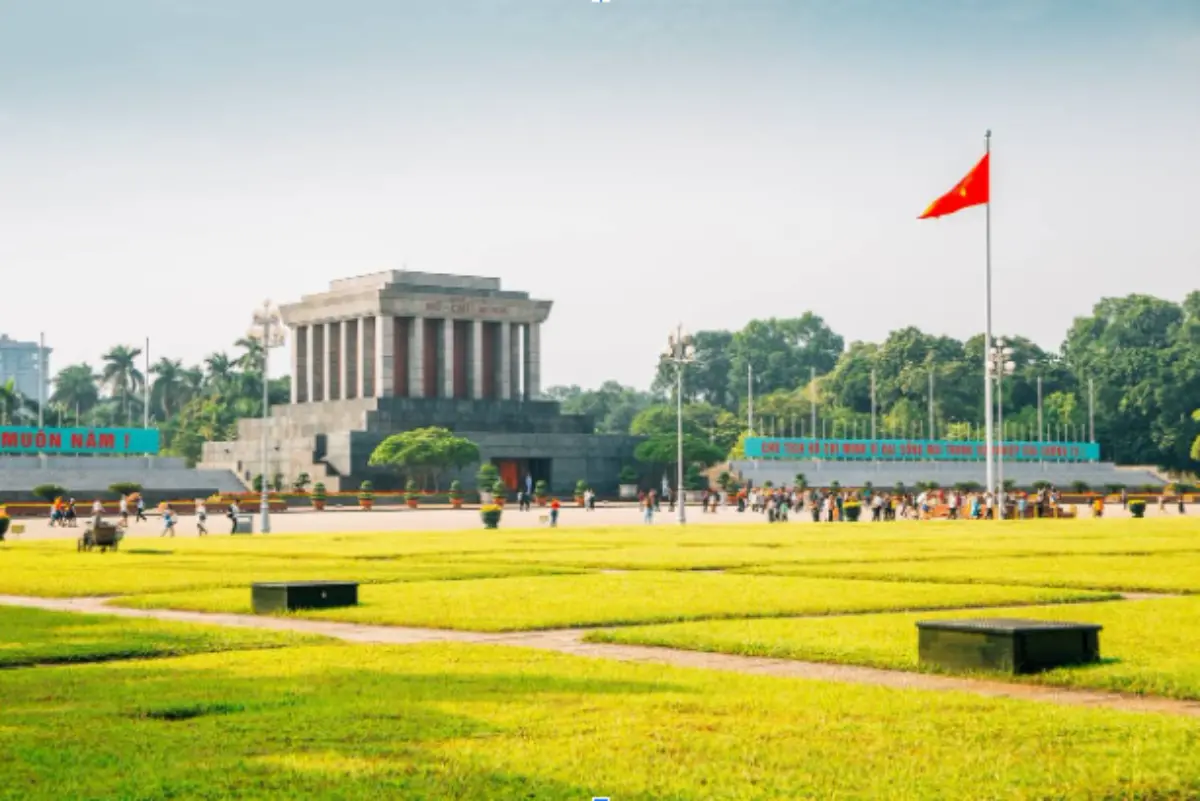
Ba Đình Square: Where Independence Was Declared
September 2, 1945
On September 2, 1945, Hồ Chí Minh stood on the platform at Ba Đình Square and read the Declaration of Independence, founding the Democratic Republic of Vietnam. The square, named for a 19th‑century uprising, became the symbolic heart of the new nation. Today, it is a vast open space, flanked by government buildings and the mausoleum. On national holidays, crowds gather here for ceremonies; on ordinary days, it is a place of quiet reflection. The platform where the declaration was read is preserved, and the flagpole at the center of the square flies the red flag with its yellow star — a constant reminder of the moment when Vietnam declared itself free.
The Mausoleum: Resting Place of a Revolutionary
Granite and Reverence
Inspired by Lenin’s mausoleum in Moscow, the Hồ Chí Minh Mausoleum was completed in 1975, six years after the leader’s death. Its granite facade is stark and monumental, a contrast to the simple life that Hồ Chí Minh lived. Inside, the embalmed body of Uncle Hồ lies in a glass sarcophagus, illuminated by soft light. Visitors file past in solemn silence, often bowing as they pass. The atmosphere is one of profound reverence. The mausoleum is open for a few hours each morning, except during the annual closure for preservation. For Vietnamese, a visit here is a rite of passage; for foreign visitors, it is an opportunity to witness the deep respect in which Hồ Chí Minh is held.
The Stilt House: A Life of Simplicity
Where the Leader Lived
Behind the Presidential Palace — a grand colonial building that Hồ Chí Minh refused to live in — stands the Stilt House where he chose to reside. From 1958 until his death in 1969, he lived in this simple wooden structure, raised on stilts in the style of the ethnic minority communities of northern Vietnam. The house has two small rooms: a bedroom and a study, furnished with a bed, a desk, and a bookshelf. The grounds include the fish pond where he fed the fish in the morning, and the path where he walked in the evening. The house is preserved exactly as it was when he lived there, a testament to a man who, at the height of his power, chose simplicity over opulence.
The Presidential Palace: French Colonial Grandeur
The Building He Refused
The Presidential Palace was built by the French between 1900 and 1906 as the residence of the Governor‑General of Indochina. It is a classic example of French colonial architecture — yellow walls, wrought iron, and grand reception rooms. When Hồ Chí Minh became president, he was offered the palace but refused, preferring the simple stilt house behind it. Today, the palace is used for state receptions and is not open to the public, but visitors can view it from the grounds. The contrast between the palace’s grandeur and the stilt house’s simplicity is perhaps the most powerful lesson of the complex: a leader who had power, and chose not to use it for personal comfort.
One Pillar Pagoda: A Lotus in Stone
Hanoi’s Most Beloved Pagoda
Just southwest of the mausoleum complex stands the One Pillar Pagoda (Chùa Một Cột), one of Vietnam’s most iconic Buddhist sites. Built in 1049 by Emperor Lý Thái Tông, the pagoda was constructed in the shape of a lotus flower rising from a single stone pillar. According to legend, the emperor was childless until he dreamed of the bodhisattva Avalokiteshvara handing him a son on a lotus flower; he built the pagoda in gratitude. The original structure was destroyed by the French in 1954, but it was rebuilt shortly after. Today, it is a symbol of Hanoi, and visitors come to admire its delicate architecture and to offer prayers. It is a place of peace in the midst of the monumental structures that surround it.
The Hồ Chí Minh Museum
Understanding the Man
For those seeking a deeper understanding of Hồ Chí Minh’s life and work, the Hồ Chí Minh Museum offers a comprehensive overview. Opened in 1990, the museum uses photographs, documents, and artifacts to trace the leader’s life — from his childhood in Nghệ An, through his years abroad, to his leadership of the independence movement. The museum’s architecture is striking, and its exhibits are thoughtfully arranged. It is not a hagiography but a genuine attempt to understand the man who became the father of modern Vietnam. A visit here adds context to the other sites in the complex.
Mausoleum Complex Tours
Half‑Day Tour: Visit the mausoleum, the stilt house, the Presidential Palace grounds, and the One Pillar Pagoda.
Extended Tour: Add the Hồ Chí Minh Museum for a deeper understanding of the leader’s life.
Combined Itinerary: Pair the mausoleum complex with the Temple of Literature and the Old Quarter for a comprehensive Hanoi experience.
Private Guide: For those seeking historical context, a private guide can provide insights into the complex’s significance.
The Essence of the Complex — The Hồ Chí Minh Mausoleum Complex is a place of contradictions: the grandeur of the French palace and the simplicity of the stilt house, the solemnity of the mausoleum and the delicacy of the One Pillar Pagoda. But in these contradictions, you find the story of modern Vietnam — a nation that emerged from colonialism, that honored its revolutionary leader with a monument, and that preserved the pagoda that has been a symbol of the city for a thousand years. To visit is to walk through history, and to understand why this place, more than any other, holds the memory of a nation.
Frequently Asked Questions
The mausoleum is open Tuesday–Thursday and Saturday–Sunday, 7:30–10:30 AM (7:30–11:00 AM in winter). It is closed on Monday, Friday, and for two months (typically September–November) for annual preservation.
Yes. Visitors must dress modestly — no shorts, sleeveless tops, or revealing clothing. Appropriate attire is required to enter the mausoleum and the complex.
No. Photography is prohibited inside the mausoleum. Photography is allowed on the grounds and in other buildings, but not inside the mausoleum itself.
A full visit to the complex (mausoleum, stilt house, One Pillar Pagoda) takes about 2–3 hours. Adding the museum extends the visit to 3–4 hours.
The grounds are accessible, but the mausoleum involves steps. There are ramps, and assistance is available for visitors with mobility concerns.
Large bags must be checked at the baggage counter. Small cameras and phones are allowed but must not be used inside.